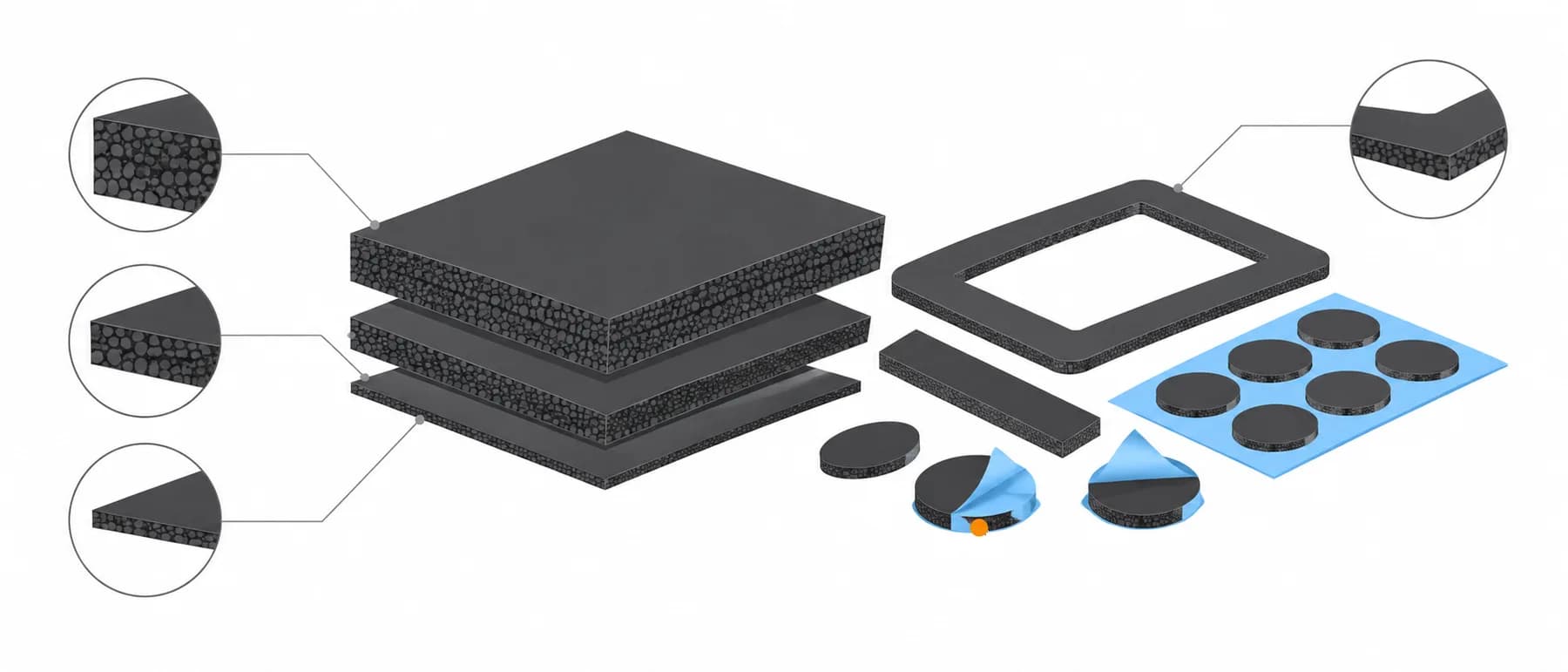
PORON foam is specified by name on a lot of drawings, and it is usually specified for the right reason: it keeps its thickness after years under compression. What the drawing rarely says is which grade, which density, and what happens to the part when the thickness changes. This guide covers the parts of PORON foam selection that datasheets imply but don't spell out: how the grades differ, why a thin PORON part is firmer than a thick one of the same grade, why standard PORON is a dust seal rather than a water seal, how it is laminated to adhesive and die cut, and what to check when two quotes for "PORON" are not quoting the same material.
What PORON Foam Is
PORON is Rogers Corporation's trademark for its family of microcellular polyurethane foams. It is made by a patented mechanical foaming process that gives a very fine, uniform cell structure, and it is supplied as sheets and rolls that converters cut into gaskets, cushioning pads, and adhesive-backed parts.
Two points are commonly misunderstood. First, PORON foam is an open-cell material. The cells are small enough that a compressed PORON part blocks dust effectively, but air and water can move through the structure; this matters for sealing and is covered below. Second, PORON is not memory foam in the mattress sense. It recovers quickly after compression; the only slow-recovery grade in the industrial range is the 4790-92 series, and even that is designed for low closure force rather than for body contouring.
The reason engineers specify PORON foam is compression set: how much thickness a foam permanently loses after being held compressed. Rogers' datasheet for PORON 4701-30 lists compression set of 0.7–1.5% maximum (ISO 1856, Test A at 70 °C, depending on density), and the 4701-40 datasheet lists 5% maximum at 23 °C and 10% maximum at 70 °C under ASTM D3574 Test D. The two figures come from different test methods, so compare grades within one method, not across them. Either way, a PORON gasket that seals on day one still pushes back on the joint years later, which is what most commodity cellular foams cannot promise.
The PORON Grades You Will Actually See on a Drawing
Rogers publishes more than a dozen PORON industrial series. Most drawings for PORON foam parts call out one of the 4701 grades, where the suffix indicates firmness. The descriptions below are Rogers' own wording; thickness ranges are from Rogers' product listings.
- PORON 4701-30 (Very Soft) — easily compressed; flexible gasketing, gap filling, and spring applications. 0.79–12.7 mm.
- PORON 4701-40 (Soft) — the general-purpose gasket and gap-filling grade, and the most common callout on enclosure drawings. 0.79–12.7 mm.
- PORON 4701-50 (Firm) — for gaskets that also manage high-energy impact. 0.79–12.7 mm.
- PORON 4701-60 (Very Firm) — energy management, spacers, bumpers, and foot pads. 0.79–6.35 mm.
- PORON 4790-92 (Extra Soft) — slow rebound and very low closure force, for thin plastic housings and displays that cannot take much force. 0.53–12.7 mm.
- PORON Soft Seal 4701-15 — Rogers' lowest-density PORON at 6 lb/ft³, made for sealing where very little closure force is available.
- PORON ShockSeal — impact protection in thin designs, down to 0.5 mm, used behind LCD displays.
- PORON AquaPro (4701-37, 4701-41) — the series Rogers positions for water sealing. 0.15–12.7 mm.
- PORON ThinStik — PORON supplied with pressure-sensitive adhesive for ultra-thin gaps.
- PORON 40V0 — the grade to specify when the part must meet UL 94 V-0.
If a drawing just says "PORON" with a thickness, ask which grade was intended. 4701-40 is the usual default, but a pad designed around 4701-30 behaves very differently in a tight gap, and a drawing that needs V-0 or water sealing needs a different series altogether.
Why a Thin PORON Part Is Firmer Than a Thick One
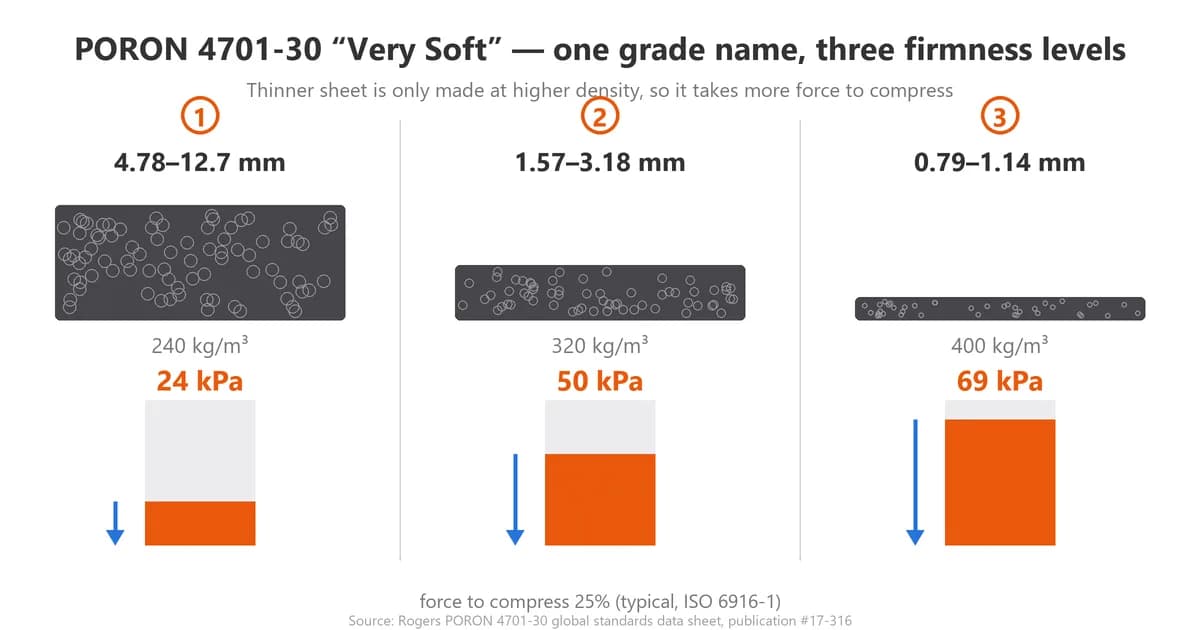
This is the detail that catches most first-time PORON foam designs. Each 4701 grade is made in several densities, and the density you get is tied to the thickness you order. Thin sheets are only made in the higher densities, and higher density means higher compression force.
Rogers' global-standards datasheet for PORON 4701-30 (Very Soft) shows it clearly. At 240 kg/m³ the material is made from 4.78 to 12.7 mm thick, with a compression force of about 24 kPa at 25% deflection. At 320 kg/m³ it covers 1.57 to 3.18 mm, at about 50 kPa. Below that, 0.79 to 1.14 mm is only made at 400 kg/m³, at about 69 kPa. So a 1 mm "very soft" pad needs roughly three times the force to compress by 25% as a 6 mm pad of the same grade name. The 4701-40 datasheet follows the same pattern: a typical 41 kPa at 240 kg/m³ (3.18–12.7 mm), 76 kPa at 320 kg/m³ (1.57–3.18 mm), and 173 kPa at 480 kg/m³ (0.79–1.14 mm).
What to do when you need thin and soft
- Move down a grade: a thin 4701-30 part is softer than a thin 4701-40 part at the same thickness.
- Consider 4790-92, the extra-soft slow-rebound series, which Rogers makes down to 0.53 mm.
- Reduce the contact area. Closure force scales with gasket area, so a narrower gasket bead or a pattern of pads can bring total force down without changing the material.
- Ask for the compression force curve for the exact density you will receive, not the grade's headline value.
Choosing PORON Thickness for a Gap
A PORON gasket or pad is sized by working backward from the gap it will sit in. Start with the nominal gap and its tolerance stack: the smallest and largest gap the assembly can actually produce. The part has to stay in contact at the largest gap and must not demand more force than the housing, clips, or screws can supply at the smallest gap.
Then add the material's own thickness tolerance, which is separate from the cutting tolerance. Rogers lists PORON thickness tolerance at ±10% for most density bands, widening to ±15–20% for the thinnest sheet. On a 1 mm part that is ±0.1–0.2 mm of thickness variation before anything else is considered. It often matters more than the gap tolerance of a molded housing.
Finally, read the compression force at both ends of that range from the curve for the density band you will actually get. If the force at maximum compression is higher than the assembly can supply, the answer is usually a softer grade or a smaller contact area, not a thinner part, because a thinner part moves into a higher density band and gets firmer.
Two tolerances, not one
Die cutting controls the outline. On precision flatbed equipment PORON foam holds an outline tolerance of about ±0.1 mm, the best of any foam we convert. Thickness is controlled by the foam manufacturer, not the die, so it follows the ±10% band above. When a drawing gives a single tolerance for a PORON part, confirm whether it applies to the outline, the thickness, or both.
Dust Sealing vs Water Sealing
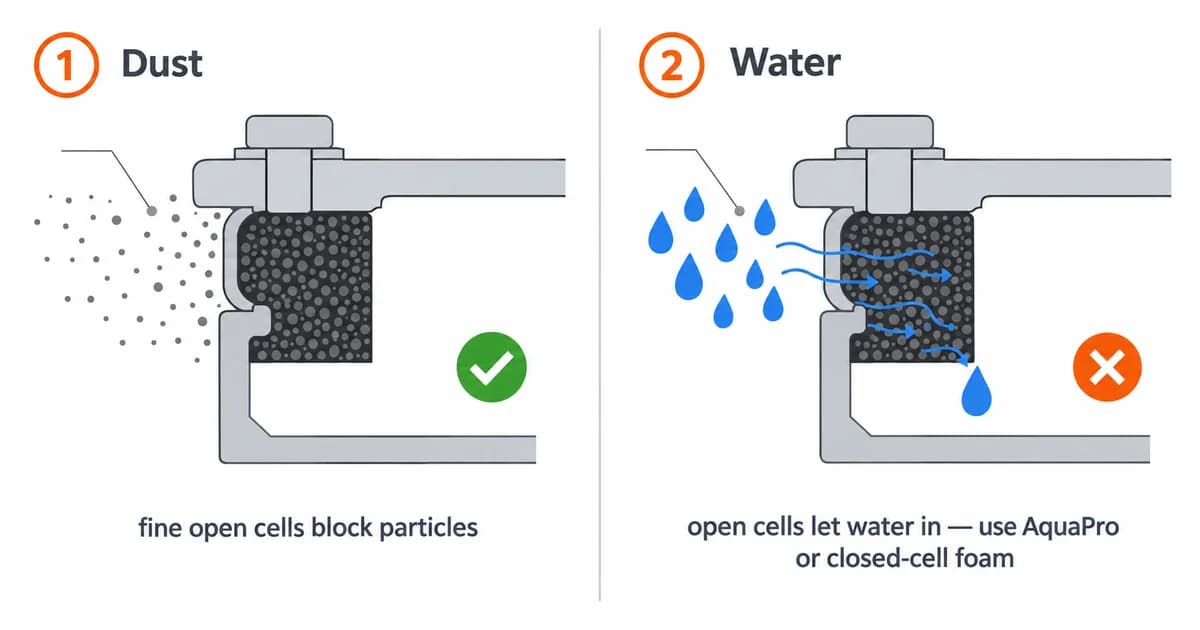
Because standard PORON foam is open-cell, it absorbs water when it is immersed. Rogers' 4701-40 datasheet lists water absorption after immersion of 11–17% weight gain depending on density, against 2% in a high-humidity exposure test. Under compression the fine cell structure makes an effective barrier against dust, light, and airborne particles, which is why PORON foam is the default for electronics enclosure dust gaskets, display light-block gaskets, and battery-pack spacers.
For a joint that must keep out liquid water, don't rely on standard PORON foam just because it seals well against dust. Rogers positions the AquaPro series specifically for water sealing. The alternatives are a closed-cell material, such as closed-cell silicone sponge, neoprene, or EPDM sponge, or a design where the foam is compressed hard enough that the test standard in question is actually passed. Whichever route you take, validate it against the ingress rating you need, not against a datasheet line.
Temperature, Flammability, and Outgassing
These are the three datasheet lines most often copied onto a drawing, and each has a detail worth knowing.
- Temperature: Rogers lists 90 °C maximum for constant use and 121 °C for intermittent use on the 4701 grades, with cold-side limits of −40 °C (brittleness, 4701-40) to −55 °C (embrittlement, 4701-30). PORON foam is a moderate-temperature material. For continuous service well above 90 °C, silicone foam is the usual answer.
- Flammability: most 4701 densities meet UL 94 HBF and FMVSS 302 down to a stated minimum thickness, and the minimum thickness differs by density. Rogers also notes that since 2023, materials with a nominal density at or above 250 kg/m³ are no longer eligible for UL 94 HBF testing but remain equivalent. If a drawing requires a current HBF listing at a higher density, raise it before production. If it requires V-0, specify PORON 40V0.
- Outgassing: the 4701-40 datasheet lists ASTM E595 total mass loss of 0.7–1.0% and collected volatile condensable material of 0.04–0.05%, depending on density. PORON contains no plasticizers, which is why it is used near optics and contacts where fogging or corrosion would be a problem.
PORON Foam Tape and Adhesive-Backed Parts
PORON foam is supplied without adhesive. What buyers call "PORON foam tape" is either Rogers' own ThinStik product, which comes with a pressure-sensitive adhesive already applied, or standard PORON that a converter has laminated to an adhesive before cutting. For most custom parts it is the second.
Adhesive choice follows the substrate, as with any foam part: acrylic transfer adhesive for metals and most engineering plastics, where long-term and high-temperature holding matters; high-tack or modified acrylic for low-surface-energy plastics such as polypropylene and powder-coated surfaces; single-sided lamination when the part must be removable or repositionable on one face. Because PORON is soft and open-cell, a thin adhesive on a carrier is often easier to handle during assembly than an unsupported transfer adhesive.
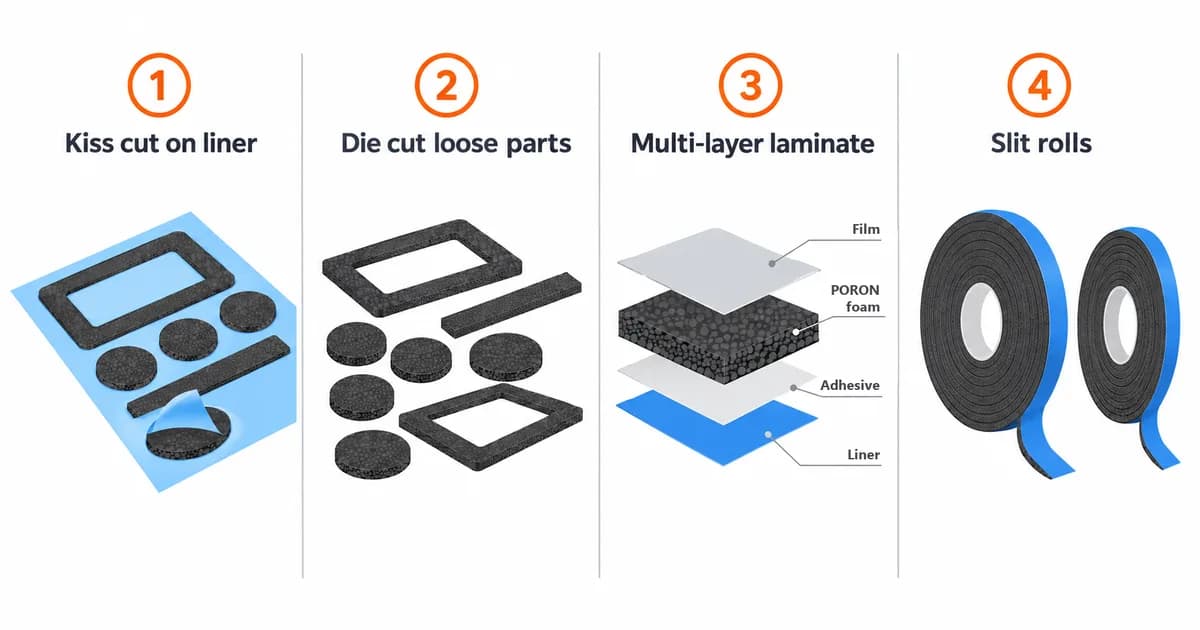
How PORON parts are usually delivered
- Kiss cut on a liner — the foam and adhesive are cut through, the liner is not, so parts peel off a sheet or roll. Best for hand assembly or pick-and-place.
- Die cut loose pieces — cut fully through, packed in bulk. Used for pads without adhesive and for larger parts.
- Multi-layer laminates — PORON combined with a film, a second foam, or a conductive layer in one cut part, so the assembler places one piece instead of three.
- Slit rolls — PORON tape in narrow widths for automatic dispensing or long straight gaskets.
PORON vs EVA, PE, Silicone, and Neoprene Foam
PORON foam is rarely the cheapest foam that fits a gap, so the question is usually what a lower-cost foam would give up.
- EVA and cross-linked PE foam — closed-cell, low cost, and good at keeping out water, but they take a noticeably larger permanent set under long-term compression. They suit parts that are compressed only briefly or don't need to keep sealing force for years.
- Silicone foam — the choice when temperature is the constraint. It covers a much wider range (about −55 to +200 °C for the grades we stock), at a higher cost and usually a lower tear strength.
- Neoprene and EPDM sponge — closed-cell rubber sponges for weather and water sealing outdoors, typically firmer at a given thickness and less consistent in thickness than PORON.
- PORON — the choice when a thin gasket has to keep pushing back for the life of the product at moderate temperature, with low outgassing and clean die cutting.
A useful test: if the part will sit compressed for years and the product fails when that part relaxes, the compression set difference is worth paying for. If the part is compressed once during assembly and the joint is also held mechanically, a closed-cell PE or EVA foam may be enough.
Sourcing PORON: What to Confirm on a Quote
PORON is a registered trademark, but the word is used loosely in quotes, especially for generic microcellular polyurethane foams. There is also a structural change buyers in Asia should know about. PORON was long produced for the Japanese and Asian markets through Rogers' joint ventures with INOAC: Rogers Inoac Corporation in Japan and Rogers INOAC Suzhou in China. On 5 November 2024, INOAC announced that the joint ventures would be dissolved. The Japanese company becomes wholly owned by INOAC, and INOAC's product is renamed SlimFlex, which INOAC describes as having equivalent specifications. The Suzhou company becomes wholly owned by Rogers. A quote for "INOAC PORON" may therefore now refer to SlimFlex, which may be a perfectly good material but is no longer PORON by name.
- Ask for the exact Rogers grade and density, for example 4701-40 at 320 kg/m³, not just "PORON 1.5 mm".
- Ask whether the material is Rogers PORON or an equivalent. If it is an equivalent, get its own datasheet and test it against your compression set and force requirements.
- Ask for a certificate of conformance with lot traceability for production orders.
- If the drawing names a flammability or outgassing standard, confirm that the specific density band meets it at your thickness.
Frequently Asked Questions
What is PORON foam made of?
PORON is a microcellular polyurethane foam made by Rogers Corporation. It is made by a patented mechanical foaming process that gives a fine, uniform open-cell structure with very low compression set.
Is PORON open-cell or closed-cell?
Standard PORON is open-cell. Under compression it blocks dust and light well, but it absorbs water on immersion — 11–17% weight gain on the 4701-40 datasheet. For water sealing, specify the AquaPro series or a closed-cell material.
Is PORON the same as memory foam?
No. Memory foam is a slow-recovery viscoelastic foam used mainly for comfort products. Standard PORON grades recover quickly and are chosen for long-term resistance to compression set. PORON 4790-92 is a slow-rebound grade, but it is designed for low closure force in electronics, not for body contouring.
What temperature can PORON foam handle?
Rogers lists 90 °C maximum constant use and 121 °C intermittent use for the 4701 grades, with low-temperature limits of −40 to −55 °C depending on grade. For continuous service above 90 °C, silicone foam is usually the better choice.
Why is my thin PORON part firmer than expected?
Thin PORON sheet is only made in higher densities. For 4701-30, the 0.79–1.14 mm band is made at 400 kg/m³ with about 69 kPa at 25% deflection, while the 4.78–12.7 mm band is made at 240 kg/m³ with about 24 kPa. Use a softer grade or a smaller contact area instead of a thinner part.
Can PORON foam be die cut with adhesive?
Yes. PORON is laminated to a pressure-sensitive adhesive and then kiss cut on a liner or die cut into loose parts. Outline tolerance of about ±0.1 mm is achievable on precision flatbed equipment. Thickness tolerance comes from the foam itself, typically ±10%.
Send Us Your PORON Drawing
ALS Tape converts Rogers PORON into kiss-cut and die-cut gaskets, pads, and adhesive-backed parts. Send a drawing or sample with the gap, the assembly method, and any flammability or sealing requirement, and we will confirm the grade, density band, and adhesive before quoting.
Contact ALS Tape