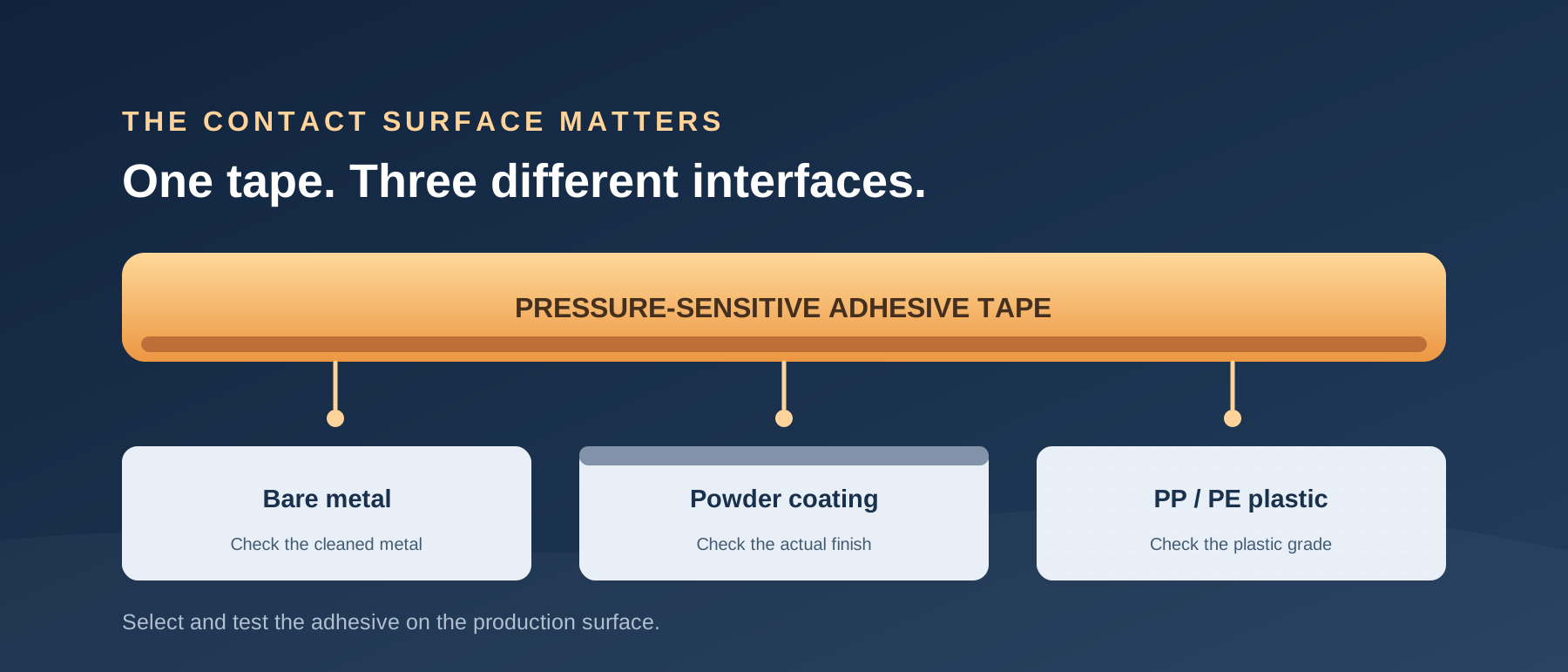
If double-sided tape will not stick to plastic or powder-coated metal, start by checking where the bond failed. Clean separation, split adhesive, damaged coating, and lifting edges call for different checks. Use the table below to narrow down the cause, then compare tape options on actual production parts. This guide covers industrial pressure-sensitive adhesive (PSA) tapes.
What Should You Check First When Tape Does Not Stick?
- Identify the material and finish on each side of the joint. Check separately for contaminants such as oil or mold-release residue. On powder-coated metal, the adhesive contacts the coating.
- Inspect the failed sample. Did the tape separate cleanly, did the adhesive split, or did paint or foam tear away? These observations help locate the failure.
- Check the cleaning method, application temperature, and pressure against the tape manufacturer’s instructions. Record the time between assembly and testing.
- For polypropylene (PP) or polyethylene (PE), shortlist grades designed for low-surface-energy (LSE) plastics. For powder coatings or silicone rubber, check compatibility with the specific finish or rubber grade.
- Test the loads and environmental conditions relevant to the assembly, including edge lift on the finished part. A peel value measured on stainless steel does not establish performance on your plastic.
What Does the Failed Bond Tell You?
Inspect both surfaces before cleaning the failed part. Separation at the adhesive-to-substrate interface is adhesive failure; splitting within the adhesive is cohesive failure. The foam, coating, or substrate can also fail, and a single sample may show more than one failure mode.
Residue is a clue, not proof of the root cause. Photograph both sides and label them A and B. Thin residue and mixed failures can be difficult to distinguish by eye.
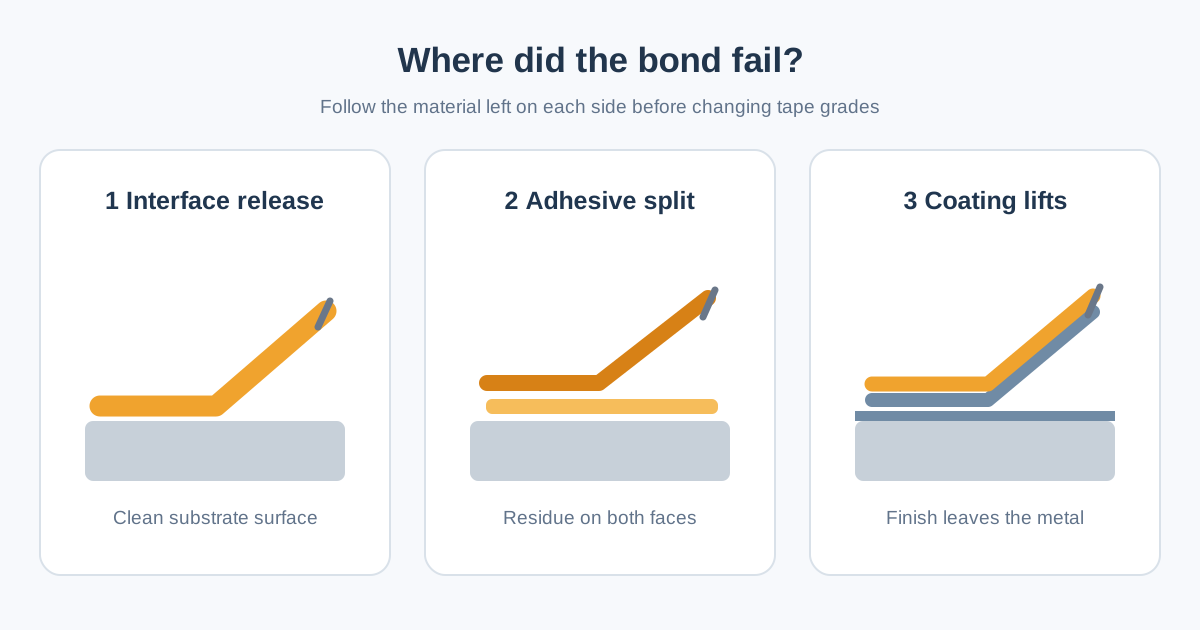
| What you see | Check first | Next controlled trial | How to read the result |
|---|---|---|---|
| One surface looks clean | Identify the surface that released. Check its material, finish, possible contamination, and application records. | Keep tape, geometry, pressure, temperature, and dwell time fixed. Compare the current cleaning method with an alternative approved for both surfaces. | If it still releases, check application conditions in separate trials, then compare a grade suited to the surface. Cleaning alone does not establish long-term compatibility. |
| Adhesive residue on both surfaces | Check for adhesive splitting, foam tearing or mixed failure; note temperature and sustained load. | After checking for process deviations, compare a tape rated for the required temperature and load. Keep bond area, test conditions, and load the same. | Record creep (movement under sustained load) and time to failure as well as peel. Higher initial tack may not solve the problem. |
| Paint, coating or foam comes away | Identify the torn layer and whether the coating detached from the metal. | Have the part supplier verify coating or substrate integrity before repeating the tape comparison. | A tape cannot repair a coating-to-metal failure. Treat a finish change as a new test condition. |
| Edges lift; the center remains bonded | Check curvature, spring-back, thermal movement, contact area and time before loading. | Compare flat specimens with actual parts using the same tape, surface finish, and application process. Then vary one design or process factor. | If only the actual part fails, investigate geometry and assembly conditions. Verify that the specimens had comparable surfaces before attributing the difference to shape. |
Change one factor at a time during diagnosis. Once the likely cause is identified, validate the complete proposed material and assembly process together.
What Surface Is the Adhesive Actually Touching?
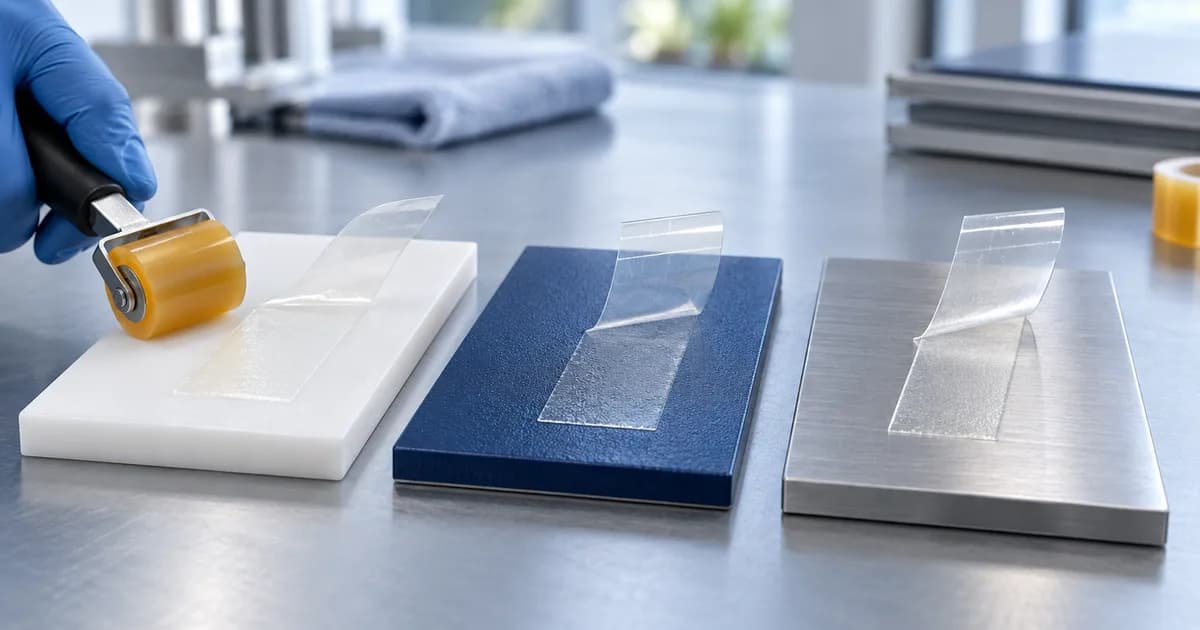
The adhesive contacts the outermost surface. Clean, stable aluminum and stainless steel surfaces are generally easier to bond with many PSAs than untreated PP or PE. A powder coating changes that surface; its formulation and texture affect adhesion. Mold-release residue, paint, or a silicone coating can also change how a plastic part bonds.
Specify the two interfaces separately: for example, a PP housing on side A and powder-coated aluminum on side B. Some tapes use different adhesives on opposite faces; others use one adhesive suited to both. Record the plastic grade and finish rather than describing the joint only as “plastic to metal.”
Why Does Tape Stick to Aluminum but Not PP or PE?
PP and PE, including high-density polyethylene (HDPE), have low surface energy. Many general-purpose adhesives cannot wet out these surfaces well enough to form a reliable bond. Wet-out means the adhesive spreads into close contact with the surface. Strong initial tack—the immediate grip—does not establish durability under peel, sustained load, or aging.
Start with a pressure-sensitive adhesive whose manufacturer explicitly lists the plastic and application. Modified acrylic or other LSE-specific systems are options; the exact choice depends on the grade, additives, finish, temperature, and the other bonding surface. A primer or surface treatment can be a separate option when the approved process allows it. Do not assume that all acrylic tapes, or every tape described as 'industrial', are suitable for untreated PP and HDPE.
Why Can Tape Fail on Powder-Coated Aluminum?
The tape bonds to the powder coating. Its chemistry, texture, cure condition, and additives can affect adhesion; finishes with different gloss levels may also behave differently. Test parts with the actual production coating and review the bond if the finish or supplier changes. This section concerns bonding after coating; a tape that bonds to a finished panel is not automatically suitable for a powder-coating oven cycle.
If a trial releases cleanly from the coating, compare a tape grade documented for that finish, improve the approved cleaning and application process, or evaluate a compatible primer with the coating supplier. If the coating pulls off the metal, replacing the tape alone will not repair the coating-to-metal interface.
Will a Tape for PP Also Bond to Silicone Rubber?
Do not group silicone rubber with PP simply because both can be difficult to bond. Silicone surfaces often need an adhesive specifically selected for silicone. Some double-sided constructions place silicone adhesive on one face and acrylic on the other, but the construction has to match which side touches silicone and which side touches the mating part.
A polyimide masking tape with silicone adhesive is a different product from a double-sided mounting tape for silicone rubber. Specify the silicone grade, surface condition, mating material, temperature, and whether the bond must be permanent or removable.
Which Tape Options Should You Compare?
Match the adhesive to both contact surfaces and the tape construction to the joint. LSE is a property of a surface; “LSE tape” refers to tape designed to bond to such surfaces. Transfer adhesive, film-carrier tape, and foam tape describe different constructions. A foam carrier alone does not make an adhesive suitable for PP.
Use this table to request candidate technical data sheets. It is a screening framework, not a list of grades already qualified for your assembly.
| Joint requirement | Options to consider | Data to compare | When to investigate further |
|---|---|---|---|
| Thin bond on smooth, closely fitted parts | Transfer adhesive or a thin film-carrier double-sided tape; select a grade qualified for each face. | Adhesive-layer and total thickness; peel on the actual substrates; temperature limits and shear performance; release liner and handling. | The bond has gaps or texture the thin layer cannot contact, or substrate-specific evidence is missing. |
| Texture, a small gap or differential movement | Conformable foam or acrylic foam with an adhesive grade suited to both finishes. | Thickness versus measured gap; ability to conform; shear and creep at service temperature; peel on the actual finish. | Foam thickness disrupts fit, edges remain under peel stress, or the coating itself is weak. |
| PP or PE on either face | A grade designed for LSE plastics, with a construction that fits the joint. | Exact plastic grade and finish; application conditions; initial and aged adhesion; any primer requirement. | Only a steel peel value or a generic “high tack” claim is available. |
| Silicone rubber on one face | An adhesive qualified for that silicone; consider different adhesives on opposite faces. | Silicone grade; adhesive orientation; total thickness; temperature limits; release liner and converting requirements. | A tape is described as suitable for PP or as silicone masking tape, without evidence for this two-sided bond. |
The ALS product pages below help compare available constructions. Confirm the exact grade and current technical sheet before specifying it; a product family name does not establish compatibility with every PP or powder-coated part.
How Should You Prepare and Test a Candidate Tape?
Set acceptance criteria before making samples: load and direction, allowable movement or edge lift, environmental exposure, and inspection times. Use the drawing or customer requirements to set limits. No single peel value or waiting time establishes that an assembly is suitable.
Keep the current tape as a baseline. Comparing it with two candidates is a practical starting point, not a required sample plan. Use the same production finish, geometry, and test method. Agree on the number of repeat specimens, use separate specimens for destructive tests, and retain every result.
Use a cleaning method approved for both surfaces, let the parts dry, and apply controlled pressure with a roller or fixture. Follow each tape’s application instructions. Record dwell time—the time between bonding and loading or testing—and the temperature during that period.
If candidates require different primers, pressures, or dwell times, record the differences. Compare each tape with its specified application process and confirm that production can follow it. This evaluates the complete process; it does not isolate the effect of adhesive chemistry.
For peel comparisons, record specimen width, peel angle, test speed, temperature, and dwell time. Report force per unit width, such as N/mm or lbf/in, and compare results obtained by the same method. A 90° result should not be treated as interchangeable with a 180° result.
For sustained shear, record bonded area, applied load, temperature, displacement, and elapsed time. If a sample has not failed when the test stops, report “no failure within the test duration.” Check early handling at the time the part is actually moved or loaded on the line, then assess the complete joint after the specified dwell and exposure. Both interfaces and the tape, coating, and substrates must meet the agreed requirements.
What Should You Record for Each Candidate?
Download the blank CSV, open it in a spreadsheet and fill one column for the baseline and each candidate. Duplicate the sheet for different substrate pairs or production finishes. Keep an individual result for each specimen; the form is a comparison aid, not a certification test method.
| Record | Include | Why it matters |
|---|---|---|
| Two contact surfaces | Side A / B material grade, finish, texture and production lot. | “Plastic to metal” leaves the actual interfaces undefined. |
| Candidate and source | Exact tape grade, lot, adhesive on each face, thickness and technical-sheet revision. | A family name or a steel peel number is not enough to repeat the trial. |
| Assembly process | Cleaning and primer; application temperature; pressure or roller setting; passes; dwell time and temperature. | Process changes can explain an apparent material improvement. |
| Part and load | Drawing revision, bond area, gap, load direction/magnitude and fixture. | Area and edge stress affect the comparison. |
| Test and acceptance | Repeat specimens, method, peel width/angle/speed, shear area/load, exposure, inspection times, and acceptance limits. | Set the limits before reviewing results. |
| Individual outcomes | Peel force per unit width; shear displacement and elapsed time; edge lift; failure location; photo ID. | A stronger peel result can hide a different failure mode. |
Retain failures as well as passes. If the coating, plastic grade, supplier, adhesive or assembly process changes, review whether the qualification must be repeated.
Example: A PP Housing Bonded to a Powder-Coated Panel
Consider a PP housing bonded to a powder-coated panel. In this hypothetical example, the tape stays on the panel and the PP surface appears clean after separation. Check for thin residue or mixed failure, then investigate the PP interface first. The coated side still needs to be tested under the intended service conditions.
- Record the PP grade and molding finish as side A and the powder-coat specification as side B. Photograph the residue and check the original application conditions.
- Repeat the current tape with controlled, approved preparation. If the PP face still releases, shortlist candidates whose suppliers document bonding to that PP and the actual coating.
- Compare the baseline and candidates on identical parts. If a candidate requires a primer, evaluate the tape and primer together and confirm that the additional step fits the production process.
- Compare the required early handling, sustained loading and environmental conditions. Recheck both faces after failure: improvement on PP can move the weakest point to the coating or adhesive layer.
The purchasing decision should include test performance, total bond thickness, process time and the required liner/die-cut format. Do not approve a candidate solely because it feels harder to peel by hand.
What Information Do You Need for a Quote?
Send the following information to help narrow down the tape and converting options. If a detail is not yet known, identify it as an open question.
- Both contact surfaces: material grades, coatings, textures, and any cleaning or surface treatment.
- Part requirements: a DXF, DWG, dimensioned PDF, or sketch; bond area; thickness or gap; and critical dimensions.
- Operating conditions: load and direction, application and service temperatures, moisture or chemical exposure, and whether removal is required.
- Assembly and delivery: time before handling, release-liner requirements, target quantity, and loose parts or kiss-cut parts (cut through the tape while leaving the liner intact).
- Existing evidence: the current tape grade, failed-part photos, and any completed comparison worksheet.
The indicative minimum is 100 die-cut pieces or one roll, subject to material and tooling. Sample lead times are estimated at 3–9 days. Confirm the start date, business versus calendar days, and whether tooling and shipping are included in the project quote.
Arrange candidate material for testing on the actual substrates before committing to production tooling. A completed worksheet helps the discussion, but you can start with a drawing and a description of the problem.
Frequently Asked Questions
Why does double-sided tape stick at first and then fall off?
Initial tack does not establish long-term holding power. Check sustained load, temperature, time before loading, edge stress, contamination and coating integrity. Record where the joint failed, then compare the current tape and candidates under the same service conditions.
Do all acrylic double-sided tapes stick to polypropylene?
No. PP is a low-surface-energy plastic, and general-purpose acrylic grades may release from it. Select a grade whose manufacturer documents PP bonding and test it on the actual PP part and finish.
Why does tape stick to bare aluminum but peel from powder-coated aluminum?
The tape contacts the powder coating rather than the underlying metal. Coating chemistry, texture, additives, and surface contamination can change the result. Test a tape qualified for the actual production coating.
Does a stronger tape fix edge lift?
Not necessarily. Edge lift can come from curved geometry, residual stress, thermal movement, poor wet-out, or loading before the adhesive has built strength. Identify the failure mode and compare candidate constructions on production parts.
Need Help Selecting Tape for Your Assembly?
Send your materials, surface finishes, drawing, and target quantity. Include failed-part photos or test results if available. ALS Tape can discuss tape options and quote the required die-cut parts and delivery format.
Request a Tape and Die-Cut Part Quote