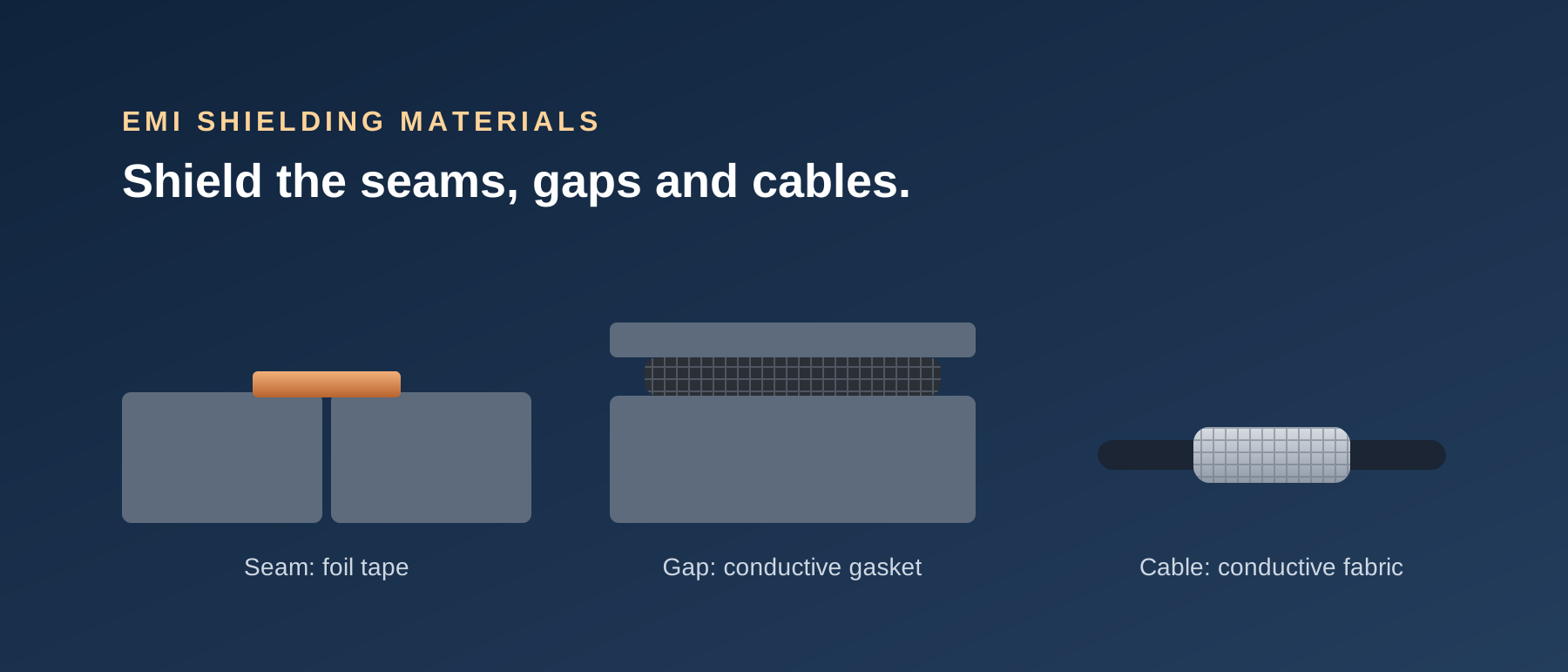
Most EMI problems in a finished product are not solved by a better sheet of metal. They are solved at the seams, grounding points, cable exits and gaps where the shield is interrupted. That is why the choice of shielding material is really a choice of form: a tape that bridges a seam, a gasket that fills a gap under compression, or an absorber that soaks up energy where reflection would cause trouble. This guide compares the common options by the job they do, what to watch for, and what to specify when you ask for die-cut parts.
Which EMI Shielding Material Should You Start With?
- Bridging a seam, grounding a flat surface or wrapping a cable on a fixed assembly: start with copper or aluminum foil tape with a conductive adhesive.
- Wrapping, folding or covering an irregular shape: start with conductive fabric tape, which conforms better than foil and survives flexing.
- Filling a gap between a door, lid or panel and the enclosure: start with a fabric-over-foam gasket or conductive foam for low closure force, or a conductive elastomer when the joint must also seal out water and dust.
- Repeated opening, sliding or wiping contact: look at metal fingerstock rather than foam or tape.
- Interference inside the device near an antenna, NFC coil or cable, where reflecting the energy makes things worse: use an absorber sheet rather than another conductive layer.
What Does an EMI Shielding Material Actually Do?
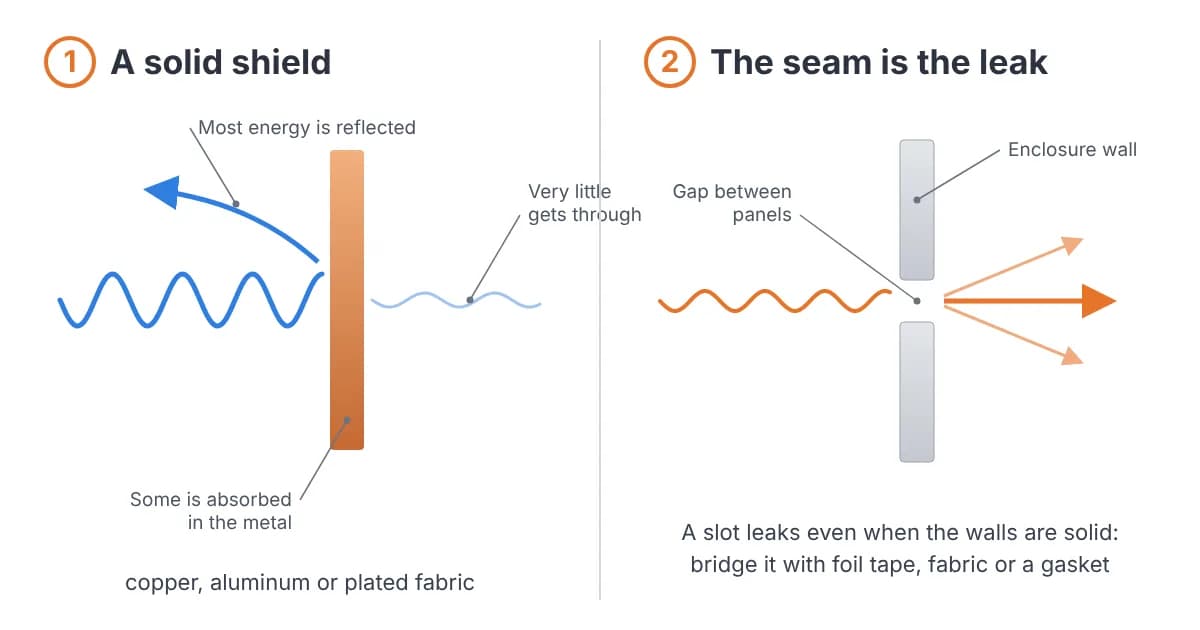
A conductive shield works mainly by reflecting electromagnetic energy and, to a lesser degree, absorbing it as it passes through the material. A continuous metal enclosure is very effective. The weak points are the places where it is not continuous: seams between panels, gaps around lids and doors, ventilation slots, display openings and the points where cables leave the enclosure.
This is why material data sheets need careful reading. A shielding effectiveness figure measured on a flat sample of tape or fabric describes the material itself. It does not tell you how well a seam bonded with that tape will perform, because the result depends on the contact resistance at both surfaces, the overlap, the pressure and any oxide or coating on the parts. An industry comparison puts the need for most commercial products at roughly 60 to 100 dB of attenuation, with some applications going higher; what you actually achieve is set by the weakest joint.
Absorbers work differently. Instead of reflecting energy, they convert part of it to heat inside a magnetic or lossy layer. They are used where a reflected wave would cause new interference, for example near an antenna or inside a crowded module, and they work over a frequency band that depends on their formulation and thickness.
How Do the Common EMI Shielding Materials Compare?
The table compares the materials most often specified for seams, gaps and internal shielding. The gasket notes follow published industry comparisons; real performance depends on the joint design and compression.
| Material | Best for | Watch out for | Typical die-cut form |
|---|---|---|---|
| Copper foil tape (conductive adhesive) | Seams, grounding strips, cable wraps on fixed parts; solderable | Kinks and tears if flexed; copper tarnishes; check resistance through the adhesive | Strips, tabs, frames, kiss-cut parts on liner |
| Aluminum foil tape | Lower-cost shielding and grounding, lighter than copper | Not solderable; oxide raises contact resistance; galvanic pairing with other metals | Strips, shapes, laminates with PET |
| Conductive fabric tape | Wrapping cables and irregular shapes; repeated flexing | Lower conductivity than solid foil; edges can fray if poorly cut | Strips, wraps, frames, tabs |
| Fabric-over-foam gasket | Door and panel seams with low closure force; lowest-cost gasket | No environmental seal; simple profiles only | Profiles cut to length, die-cut frames with adhesive |
| Conductive foam | Gap filling and grounding in compact devices | Conductivity changes with compression; check the recommended deflection | Pads, frames, gaskets on liner |
| Conductive elastomer | Seams that must also seal water and dust; complex shapes | Shielding depends strongly on compression force; higher cost | Molded, extruded or dispensed; flat sheet can be die-cut |
| Metal fingerstock | Doors and panels opened often; sliding or wiping contact | No environmental seal; plating choice matters for corrosion | Stamped strips (not die-cut) |
| Absorber sheet | Internal noise near antennas, NFC and cables where reflection is a problem | Works over a defined frequency band; not a replacement for an enclosure shield | Sheets, pads, frames on liner |
Copper or Aluminum Foil Tape: What Should You Check?
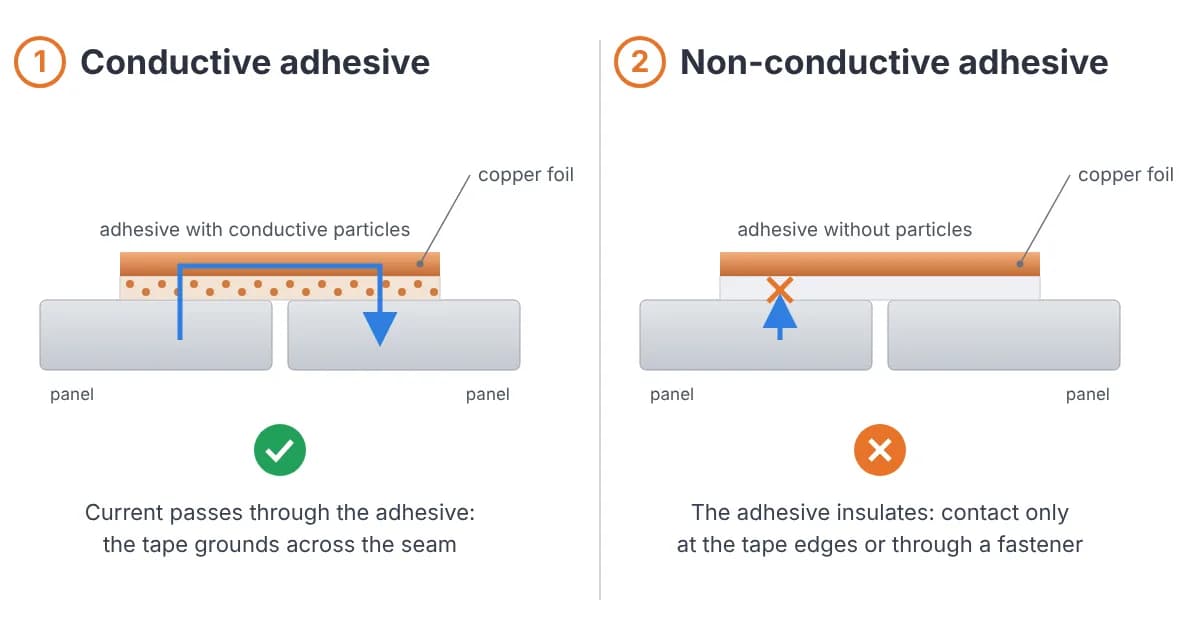
Foil tape is the simplest way to make a seam electrically continuous or to add a ground path. The adhesive matters as much as the foil. A non-conductive adhesive leaves an insulating layer between the foil and the part, so the tape only helps where its edges or a separate fastener make contact. A conductive adhesive carries particles that bridge that layer.
For conductive-adhesive tapes, look for the resistance through the adhesive and how it was measured. As an example, one widely used copper foil tape lists 0.005 Ω/sq through the adhesive, measured over 1 in² at 5 psi, and shielding effectiveness above 85 dB from 1 MHz to 2 GHz on a flat sample. Use such figures to compare tapes measured the same way, not as a prediction for your seam.
Copper is solderable and has very low resistance, which makes it the usual choice for grounding tabs and repairs on boards and cables. Aluminum is lighter and cheaper, and it is common in larger shielding wraps and laminates with PET film. Aluminum forms an oxide that raises contact resistance, and it can corrode when paired with copper or silver-plated parts in humid conditions, so check the mating surface.
Have a seam, cable or gap to shield? Send the drawing and the shielding job for a quote. A business manager replies within 24 hours.
Get a quote- Foil, conductive fabric, conductive foam and absorber parts
- Kiss-cut on liner or loose parts
- Die-cut parts from 100 pcs
- Custom samples in 3–9 days
When Is Conductive Fabric Better Than Foil?
Conductive fabric is a woven or nonwoven polyester coated or plated with metals such as nickel and copper. It conducts less well than solid copper foil, but it bends, folds and wraps around cables and corners without cracking, and it tolerates repeated flexing. That makes it the usual choice for cable wraps, hinge areas and shields that must follow an irregular shape.
When comparing fabric tapes, look at surface resistance, resistance through the adhesive, the plating (nickel-copper is common because nickel resists corrosion), and the adhesive's temperature range. Ask how the edges are cut: a clean die-cut or laser-cut edge sheds fewer fibres than a torn or slit edge, which matters inside electronics.
Fabric-Over-Foam, Conductive Foam or Conductive Elastomer for Gaps?
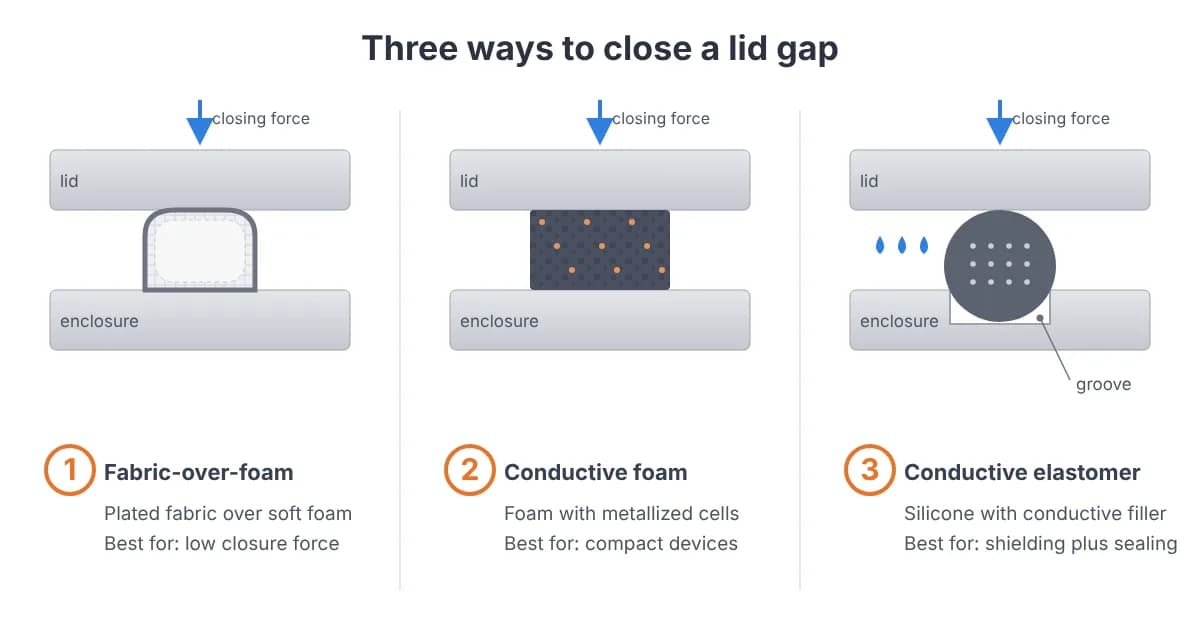
A gap between a lid or door and the enclosure needs a material that stays in contact when the joint is closed. Fabric-over-foam gaskets are the lowest-cost option and need little force to compress, so they suit sheet-metal doors and covers that cannot take a high closing load. They do not seal out water or dust.
Conductive elastomers are silicone or fluorosilicone filled with conductive particles such as nickel-coated graphite or silver-plated aluminum. They can seal against water and dust and can be molded, extruded or dispensed into complex shapes, but their shielding depends strongly on how much they are compressed, and they cost more.
Conductive foam pads are common in compact devices such as phones and handheld equipment, where a small pad both fills a gap and grounds a shield can or frame. Their conductivity changes with compression, so design the gap to keep the foam within the deflection range the manufacturer recommends. Where the joint is opened often or slides, metal fingerstock lasts longer than foam or elastomer.
When Do You Need an Absorber Instead of a Shield?
A conductive shield reflects energy. Inside a small device that reflected energy has to go somewhere, and it can couple into an antenna, an NFC coil or a sensitive trace. Absorber sheets contain magnetic particles in a flexible binder and turn part of the energy into heat. They are placed on the inside of a cover, over a noisy component or between a coil and a metal battery or frame.
Absorbers are specified by frequency range and thickness. Thin sheets in the range of about 50 to 350 µm are typical in consumer electronics, with formulations tuned for bands between roughly 100 MHz and several GHz. Ask the supplier for attenuation or permeability data at your frequency, because an absorber that works well at one band can do little at another.
Why Do Galvanic Compatibility and Environment Matter?
A shielding joint is two metals in contact, often with moisture present. If the metals are far apart in the galvanic series, the less noble one corrodes and contact resistance rises over time, which can undo the shielding. Match the gasket or tape finish to the enclosure where you can, and pay attention to plated finishes on fingerstock and to filler choice in elastomers.
Also check the service temperature of the adhesive, the effect of humidity and salt spray on the coating, and whether the enclosure surface is painted, anodized or chromate-converted. A non-conductive finish under a gasket or tape blocks the contact unless the surface is masked or the coating is conductive.
What Should You Consider When Designing Die-Cut Shielding Parts?
Most shielding tapes, fabrics, foams and absorbers can be converted into parts that are ready to place: grounding tabs, frames around display openings, cable wraps, pads that bridge a shield can to a chassis, and laminated stacks of absorber and insulating film. A few points make these parts easier to apply and more consistent.
- Specify the conductive path: which face must contact which surface, and whether the adhesive must be conductive.
- Allow enough overlap on seams so the conductive adhesive area is large enough for the resistance you need.
- Add a pull tab or an extended liner where parts are applied by hand, and kiss-cut on a carrier for automatic placement.
- For foam and gasket parts, give the installed gap so the part can be cut to the right thickness for its recommended compression.
- Where shielding must not touch nearby circuits, laminate an insulating film such as PET or polyimide on the exposed side.
What Information Do You Need for a Quote?
- Drawing (DXF, DWG, PDF or STEP) or a sample part
- Material type or grade, or the job: seam bridging, grounding, gap filling or absorption
- Whether the adhesive must be conductive, and any resistance target
- Frequency range of concern for absorbers
- Installed gap and closure force for foam and gasket parts
- Quantity per order and annual volume, and whether parts are applied by hand or by machine
Frequently Asked Questions
Is copper or aluminum tape better for EMI shielding?
Copper has lower resistance and can be soldered, so it is the usual choice for grounding tabs and repairs on boards and cables. Aluminum is lighter and cheaper and is common for larger wraps and laminates. Aluminum's oxide raises contact resistance, and it can corrode against copper or silver in humid conditions.
Does EMI shielding tape need a conductive adhesive?
If the tape must make an electrical connection through its adhesive face, yes. A non-conductive adhesive insulates the foil from the surface below. Check the data sheet for resistance through the adhesive and the test conditions.
What is the difference between EMI shielding and EMI absorption?
Shielding materials are conductive and mainly reflect energy to keep it in or out of an enclosure. Absorbers contain magnetic or lossy materials that convert part of the energy to heat. Absorbers are used inside devices where reflected energy would cause new interference, for example near antennas or NFC coils.
Can EMI shielding materials be die-cut to custom shapes?
Yes. Conductive foil and fabric tapes, conductive foam and absorber sheets are commonly die-cut into tabs, frames, wraps and pads, either as loose parts or kiss-cut on a liner for automatic placement. Molded elastomer gaskets and stamped fingerstock are made by other processes.
Need Die-Cut EMI Shielding Parts?
Send a drawing or sample, the shielding job and the quantity. We convert conductive foil and fabric tapes, conductive foam and absorber sheets into parts cut to your drawing.
Just your email and what you need. Drawing optional. Stock material samples are free.