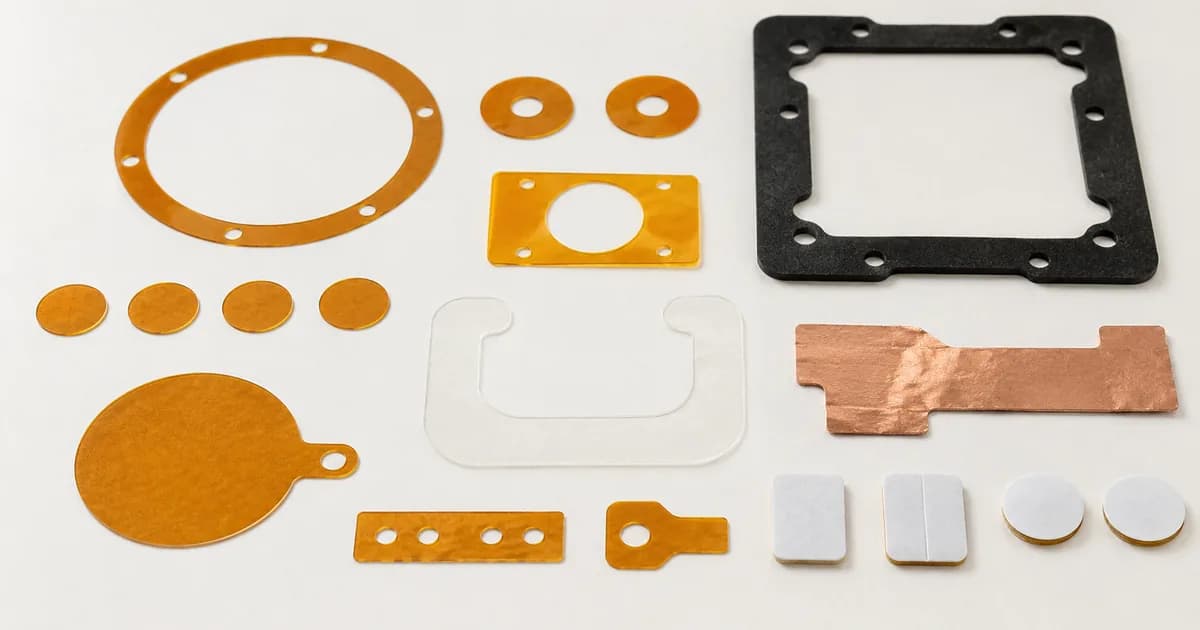
Engineers and buyers specifying technical die-cut tape parts need to start from one question: what tape construction does the application require? The die cutting process is the same across tapes, but each construction — single-coated, adhesive transfer, double-coated, foam and VHB, polyimide, conductive — behaves differently on the press and serves a different function in the assembly. This guide is organized by tape construction: what each one is, what die-cut parts it produces, the converting challenges specific to it, and the tolerances you can expect.
What "Die Cutting of Tapes" Means
Die cutting of tapes is the converting of pressure-sensitive adhesive tape — supplied in jumbo rolls — into precision parts of a defined shape, in volume, using a shaped cutting die. The output is a ready-to-apply adhesive component: a gasket ring, a mounting pad, a perimeter frame, an insulating washer, a shielding strip — identical part to part, delivered on a liner for peel-and-place application.
Tape is not an ordinary substrate to cut. Unlike a sheet of plastic or fabric, an adhesive tape is a layered construction — adhesive, sometimes a carrier, and a silicone release liner — and the adhesive is exposed at the cut edge. That changes everything about how it converts: the adhesive can ooze under die pressure, the liner has to survive cutting without being severed when a kiss cut is required, and the waste matrix has to lift away cleanly without the tacky web tearing the parts. Successful die cutting of tapes is as much about controlling the adhesive and liner as it is about cutting the shape.
Because the converting behavior is driven by the construction, the right way to specify a die-cut tape part is to choose the construction first, then the shape. The sections below walk through each construction in the order an engineer typically evaluates them.
Why Convert Tape Into Die-Cut Parts
Buying tape on rolls and cutting it at the bench is the default — until volume makes it the bottleneck. Converting the tape into die-cut parts moves the cutting upstream to a converter with shaped tooling, and the payoff shows up across the line.
Die-cut tape parts eliminate manual cutting, removing both the per-unit labor and the dimensional scatter of operators cutting strips by hand. Every part is identical and correctly sized, so downstream assembly is faster and more repeatable. For many bonding and sealing jobs, a die-cut adhesive part also replaces mechanical fasteners — screws, rivets, clips — reducing part count, weight, and assembly steps while distributing load across the full bond area instead of point stresses. And kiss-cut delivery on a liner lets an operator peel and place one part at a time without ever touching the adhesive face, which protects the bond and speeds the cycle.
Die-Cut Tape Parts by Construction Type
Every die-cut tape part starts from one of a handful of constructions. Each is defined by what is — or is not — between the adhesive faces, and that single difference determines its function, its converting behavior, and what it costs.
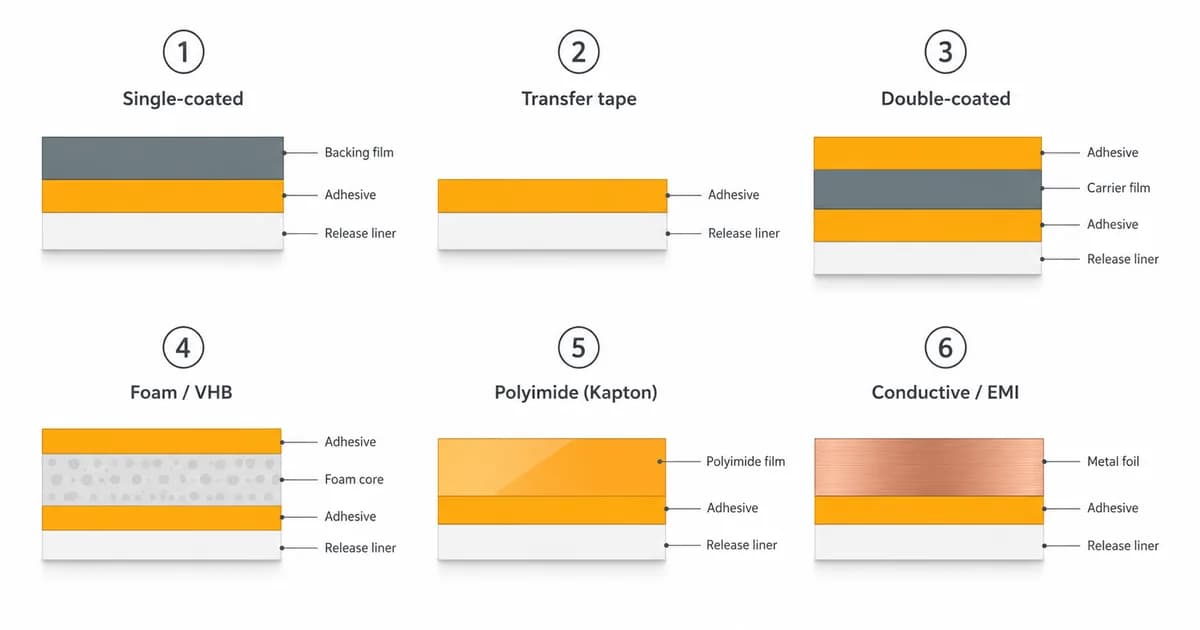
Single-Coated Tapes
A single-coated tape has adhesive on one face and a backing — paper, film, foil, cloth — on the other. Die-cut into parts, it produces masking shapes, surface-protection discs and frames, labels, and insulating or light-blocking patches. Polyimide single-coated tape die-cut into circles and rings is a staple for masking gold contacts, connector pins, and PCB pads through high-temperature wave solder and reflow, while PET versions handle lower-temperature plating and powder-coat masking.
Single-coated tape converts cleanly because only one adhesive face is exposed and the backing gives the part dimensional stability. It is the most forgiving construction to die-cut and holds tight tolerances well.
Adhesive Transfer Tape
Adhesive transfer tape is adhesive only — a film of pressure-sensitive adhesive on a release liner, with no carrier between the two bonding faces. Die-cut, it produces ultra-thin bonding parts: laminating layers, nameplate and label mounts, membrane-to-housing bonds, and any join where added thickness or a visible bond line is unacceptable. Thicknesses run from about 1 mil (25 µm) to 5 mil (127 µm).
It is the trickiest construction to convert. With no carrier, the adhesive mass is unsupported, so it oozes and bleeds at the cut edge under pressure and the unsupported web is prone to distortion. Transfer tape die cutting demands tight press pressure control and a clean matrix-removal strategy, which is why it is best left to a converter set up for it rather than cut in-house.
Double-Coated Tapes
A double-coated (double-sided) tape carries a thin carrier film — polyester, non-woven tissue, or paper — between two adhesive faces. The carrier stays in the bond, adding dimensional stability and tensile strength. Die-cut, it produces mounting pads, splicing parts, trim and emblem mounts, and bonding frames where a thin but handleable part is needed.
The carrier makes double-coated tape much easier to die-cut than transfer tape: it stiffens the part, holds tolerance, and resists distortion during matrix stripping. It is the workhorse construction for flat-to-flat bonding of smooth surfaces.
Foam & VHB Tapes
Foam tapes — including acrylic foam VHB tapes — carry a compressible foam core between two adhesive faces. Die-cut into gaskets, glazing strips, mounting pads, and sealing frames, they fill gaps, absorb tolerance and vibration, and seal against dust and moisture across uneven surfaces. Acrylic foam (VHB) parts deliver structural bonding strength high enough to replace rivets and welds in panel and trim assembly.
Foam converts well but to looser tolerances than film tapes because the core is compressible: the die compresses the foam as it cuts, so edge dimensions are read on a relaxed part, not under load. Thicker foams (1–3 mm and up) widen the achievable tolerance accordingly.
Polyimide (Kapton) Tapes
Polyimide tape — commonly known by the Kapton brand — is a single-coated film tape built for heat and electrical insulation. Die-cut into circles, rings, slots, and custom masks, it withstands wave solder, reflow, and powder-coat cycles, masks gold fingers and connector pins, and serves as a thin dielectric barrier. Polyimide film tapes with silicone adhesive hold continuous service to roughly +260°C and leave no residue on removal.
As a stable, dimensionally tight film, polyimide die-cuts to precise tolerances and is one of the cleanest constructions to convert. See our Kapton tape guide for the full properties breakdown.
Conductive & EMI Shielding Tapes
Conductive tapes — copper foil, aluminum foil, and conductive-fabric constructions, with electrically conductive or non-conductive adhesive — die-cut into shielding strips, grounding pads, gaskets, and seam-covering frames for EMI/RFI control. The die-cut part provides a defined, repeatable contact area between a shield and a ground plane that hand-cut foil cannot match.
Foil-based parts convert cleanly but the foil can burr if tooling is dull, and conductive-adhesive constructions need a converter who understands the electrical contract — whether the part must conduct through its thickness (z-axis) or only bond. Specify the conduction requirement up front.
Construction-Specific Converting Challenges
The reason die cutting of tapes is a specialty — not just "cutting" — is that the exposed adhesive and the liner introduce failure modes a converter has to design around. The common ones, and how construction drives them:
- Adhesive ooze and edge bleed: under die pressure the adhesive squeezes out at the cut edge, worst on unsupported transfer tape and soft high-tack adhesives. Controlled by press pressure, die sharpness, and sometimes chilled tooling.
- Liner selection for kiss cutting: a kiss cut severs the part but not the liner, so the part stays on the web for peel-and-place. The liner must be tough enough to survive the cut yet release cleanly — a heavier liner is specified for thin transfer tapes.
- Matrix removal: the waste web around the parts has to strip away without lifting or tearing the parts. Tacky, carrier-free constructions resist clean stripping; the part layout and weeding strategy are designed accordingly.
- Edge lift and curl: thin films and foils can curl at the cut edge or lift from the liner; stiffer carriers and correct liner release tame it.
- Foam compressibility: a foam core is elastically compressed by the die as it cuts, then recovers, so foam parts are toleranced on the relaxed part rather than under load — thicker cores get wider tolerance bands.
Tolerances and Specs by Tape Type
Achievable tolerance on a die-cut tape part depends on the cutting method and, more than anything, the construction. The process numbers are the same as for any die cutting; the construction sets where in the range a given part lands.
By Method
Flatbed die cutting presses a steel-rule die into the material and holds ±0.1–0.2 mm (±0.004–0.008") on most tape constructions. It is the choice for lower volumes, prototypes, and parts with internal geometry. Rotary die cutting feeds material through a cylindrical die and runs far faster at higher volumes, typically holding ±0.2–0.3 mm — the economical method for simple shapes above roughly 50,000 parts per run.
By Construction
Stable film constructions — single-coated PET and polyimide, double-coated with a film carrier — hold the tight end of the range and convert to precise, repeatable parts. Unsupported transfer tape and very thin films land toward the loose end because the unsupported adhesive can relax after cutting; plan for ±0.2–0.3 mm on 1–2 mil transfer tape. Foam and VHB constructions carry the widest bands because the compressible core is cut under elastic compression and measured after it recovers, scaling with core thickness. If your part needs tighter than ±0.1 mm, raise it with the converter before the design is locked — material and method may need to change.
How to Request Die-Cut Tape Parts
To get an accurate quote on technical die-cut tape parts, send the construction, the shape, and the volume. Specifically: the tape construction or function (single-coated mask, transfer-tape bond, foam gasket, polyimide insulator, EMI shield — or describe the job and let the converter specify); the part geometry as a DXF, dimensioned PDF, or even a measured sketch; whether you need a kiss cut on a liner or fully cut parts; and prototype plus target production quantities.
You do not need a finished engineering drawing to start. A sample of your current hand-cut part, or a description of the substrate and environment — temperature, sealing, conduction, masking — gives a converting team enough to recommend the construction, formalize the geometry, and confirm tolerances before any tooling is cut.
Frequently Asked Questions
What is die cutting of tapes?
Die cutting of tapes is the converting of pressure-sensitive adhesive tape from jumbo rolls into precision parts of a defined shape, using a shaped cutting die. The output is a ready-to-apply adhesive component — a gasket, mounting pad, insulating washer, shielding strip — that is identical part to part and delivered on a liner for peel-and-place application. It differs from ordinary cutting because the tape's adhesive is exposed at the cut edge and the liner must survive cutting, so controlling the adhesive and liner is as important as cutting the shape.
Can any tape be die-cut?
Almost any pressure-sensitive tape construction can be die-cut — single-coated, adhesive transfer, double-coated, foam and VHB, polyimide (Kapton), and conductive/EMI tapes all convert into die-cut parts. The construction determines how easily it cuts and what tolerance it holds: stable film tapes die-cut precisely, while unsupported transfer tapes and compressible foams require more process control and hold looser tolerances. The practical approach is to choose the construction the application needs, then confirm geometry and tolerance with the converter.
What is the difference between a kiss cut and a through cut on tape?
A through cut severs the entire tape including the liner, producing fully separated parts. A kiss cut cuts through the adhesive and any carrier but not the release liner, so each part stays on the liner web and can be peeled off one at a time for application. Kiss cutting on a liner roll is the most common delivery format for die-cut tape parts because it lets an operator peel and place a part without touching the adhesive face.
What tolerance can be held on a die-cut tape part?
Flatbed die cutting holds ±0.1–0.2 mm on most tape constructions; rotary die cutting typically holds ±0.2–0.3 mm at higher volumes. Construction sets where in that range a part lands: stable film tapes (PET, polyimide, film-carrier double-coated) hold the tight end, unsupported transfer tape and very thin films land looser, and foam/VHB tapes carry the widest bands because the compressible core is cut under elastic compression and measured after it recovers. For most sealing, bonding, and masking applications the functional tolerance needed is wider than what die cutting achieves.
Which tape construction should I choose for a die-cut part?
Match the construction to the function. Use single-coated tape for masking, surface protection, and insulating patches; adhesive transfer tape for ultra-thin bonds with no visible bond line; double-coated tape for thin flat-to-flat mounting; foam or VHB tape for gasketing, gap-filling, sealing, and structural bonding that replaces fasteners; polyimide (Kapton) tape for high-temperature masking and dielectric insulation; and conductive/EMI tape for shielding and grounding. If you are unsure, describe the substrate, environment, and function, and the converter will recommend the construction.
Request Technical Die-Cut Tape Parts
ALS Tape converts single-coated, transfer, double-coated, foam/VHB, polyimide, and conductive tapes into precision die-cut parts from our Xiamen facility — prototype through production. Send your construction or application, part geometry, and target quantity, and we respond within one business day.
Contact ALS Tape