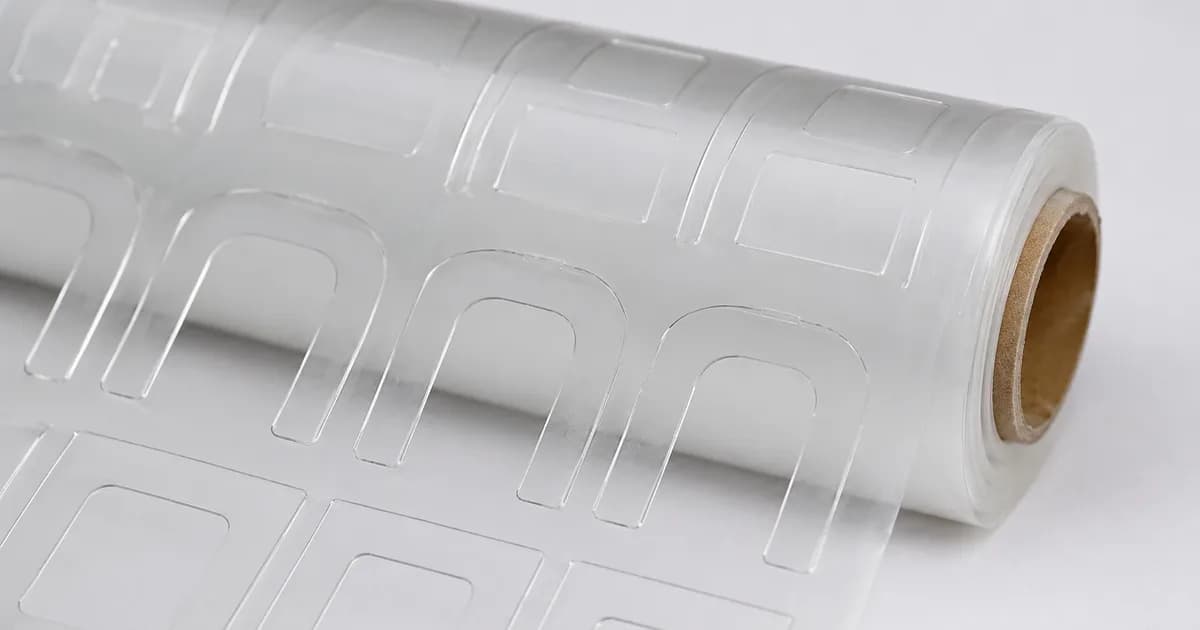
For product designers, engineers, and procurement teams who need adhesive tape in a specific shape rather than off-the-shelf rolls: this guide covers how custom die-cut adhesive tape is made, when to specify transfer tape versus double-sided backed tape, which adhesive system suits your substrate and environment (including acid-free options for archival and craft applications), what tolerances to expect, and exactly what information to send when you request samples or a production quote.
What Is Custom Die-Cut Adhesive Tape?
Standard adhesive tape comes in rolls — you cut it by hand. Custom die-cut adhesive tape starts from the same raw materials but is precision-cut at the converting facility into the exact shape your product or assembly process requires: a three-sided U-frame, a gasket ring, a perimeter border, a disc, a complex multi-aperture shape.
The result is a ready-to-apply adhesive part. In production, this eliminates manual cutting, reduces per-unit labor time, and removes the dimensional variation that comes from operators cutting strips by hand. Every part is identical, correctly sized, and ready for peel-and-place application.
Custom die cuts are available in virtually any geometry — straight-edged frames, curved profiles, slots, holes, stepped shapes. Both common adhesive constructions (adhesive transfer tape and double-sided backed tape) can be die-cut to custom shapes.
Transfer Tape vs. Double-Sided Backed Tape — Which Do You Need?
These are fundamentally different constructions, and choosing correctly matters for both assembly process and bond performance.
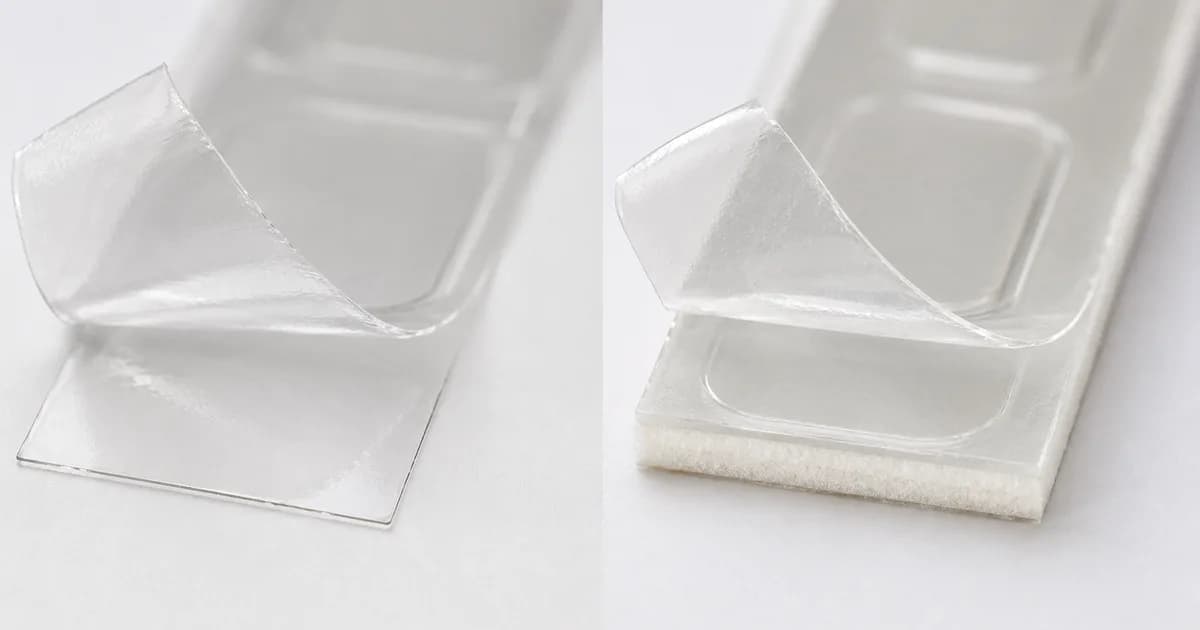
Adhesive Transfer Tape (ATT)
An adhesive transfer tape is adhesive only — a film of pressure-sensitive adhesive coated on a silicone-treated release liner, with no carrier film between the two adhesive faces. When you apply it and peel the liner, only the adhesive remains on the substrate. The result is an ultra-thin, invisible bond line with no added thickness, no carrier to tear or crinkle.
Transfer tape is the right choice when bond thickness must be minimal, when the adhesive layer must be invisible after application, or when you need conformability through a tight geometry. Thicknesses typically range from 1 mil (25 μm) to 5 mil (127 μm). For bonding a plastic sleeve to paper on three sides to create an open pocket — a typical scrapbook or product assembly use case — a custom U-shape transfer tape die cut eliminates manual strip application entirely.
Double-Sided Backed Tape
Double-sided tape carries a carrier film (polyester, non-woven, foam, paper) between two adhesive faces. The carrier remains in the bond. It is preferred when the application requires gap-filling (foam tape), when substrates have surface irregularities that need conformable adhesive mass, or when higher peel strength from a thicker construction is required.
For flat-to-flat bonding of smooth surfaces — plastic film to paper, metal foil to substrate, laminate assembly — adhesive transfer tape typically outperforms backed tape in both thinness and bond line appearance.
Choosing the Right Adhesive — Including Acid-Free Options
The adhesive chemistry determines bond performance, temperature range, and long-term stability. For custom die-cut transfer tape, three systems cover the majority of applications.
Acrylic Adhesive (Most Common for Transfer Tape)
Acrylic pressure-sensitive adhesive is the standard for adhesive transfer tape in industrial and commercial applications. It offers high initial tack and peel strength, bonds well to a wide range of substrates including paper, plastics, metals, and films, and maintains performance from approximately -40°C to +150°C.
Critically: acrylic adhesive is inherently acid-free. Properly formulated acrylic transfer tapes contain no acidic compounds and have a neutral pH, making them archival-safe for applications involving paper, photographs, artwork, and organic materials. Glass-stabilized acrylic formulations additionally resist UV yellowing — important for any assembly that will be exposed to light over long periods. When a product specification calls for an acid-free adhesive, acrylic transfer tape is the correct selection.
Rubber Adhesive
Rubber-based adhesives deliver high initial tack at a lower cost than acrylic. However, they are not acid-free — the resin systems used in rubber adhesives can off-gas and degrade paper and photographs over time. For archival, scrapbooking, or photo-mounting applications, rubber adhesive is not appropriate. For industrial assembly where long-term archival stability is not a requirement, rubber adhesive remains a cost-effective option for permanent bonding.
Silicone Adhesive
Silicone adhesive is the choice for high-temperature masking and protection applications — continuous service to +260°C, with clean removal without residue. It is not typically used in transfer tape configurations for structural bonding or paper-to-film lamination, and it is significantly more expensive than acrylic. Specify silicone adhesive when the assembly will experience process temperatures above 150°C or when residue-free clean removal is required after application.
For the majority of product assembly applications — including custom-shaped adhesive die cuts for craft production, scrapbook manufacturing, packaging inserts, and consumer product assembly — an acrylic adhesive transfer tape will be both archival-safe and the correct performance choice.
Tolerances: What Precision to Expect on a Custom Die Cut
Tolerance defines how closely the cut part will match your drawing dimensions. For adhesive film and transfer tape, the achievable tolerance depends on the cutting method and the material.
Flatbed Die Cutting
Flatbed die cutting uses a steel rule die pressed into the material. Standard tolerance for adhesive film and transfer tape on flatbed equipment is ±0.1–0.2 mm (±0.004–0.008"). This covers the majority of product assembly and industrial applications. Complex geometries, internal cutouts, and parts with tight registration between features may require review before quoting, but ±0.2 mm is achievable on most shapes. Flatbed cutting is preferred for lower volumes, prototype runs, and shapes with internal geometry.
Rotary Die Cutting
Rotary die cutting feeds material through a cylindrical die on a rotary press. It is significantly faster than flatbed and cost-effective at higher volumes, but typically holds tolerances of ±0.2–0.3 mm. For simple shapes (frames, strips, discs) in production volumes above roughly 50,000 units per run, rotary cutting is the economical choice.
Material Behavior and Tolerance Limits
Very thin, highly flexible transfer films can shift slightly during processing as the material relaxes after cutting. For ultra-thin 1–2 mil transfer tapes, plan for the upper end of the tolerance range. Stiffer liners and material combinations maintain tighter tolerances. If your application requires better than ±0.1 mm, discuss this with the converting team before finalizing the design — material selection and process method may need to be adjusted.
For the majority of product and craft assembly applications, the functional tolerance required is far wider than what die cutting can achieve. A U-shaped frame bonding a 4"×6" sleeve to paper, for example, would function correctly with ±1 mm variation — flatbed die cutting at ±0.2 mm leaves a four-fold margin.
How to Submit Your Custom Die-Cut Adhesive Tape Spec
Most first-time inquiries arrive without a formal drawing — that is fine. A converting facility can work from a dimensioned sketch, a physical sample of your current manual process, or a description of the shape you need applied. Here is what to prepare.
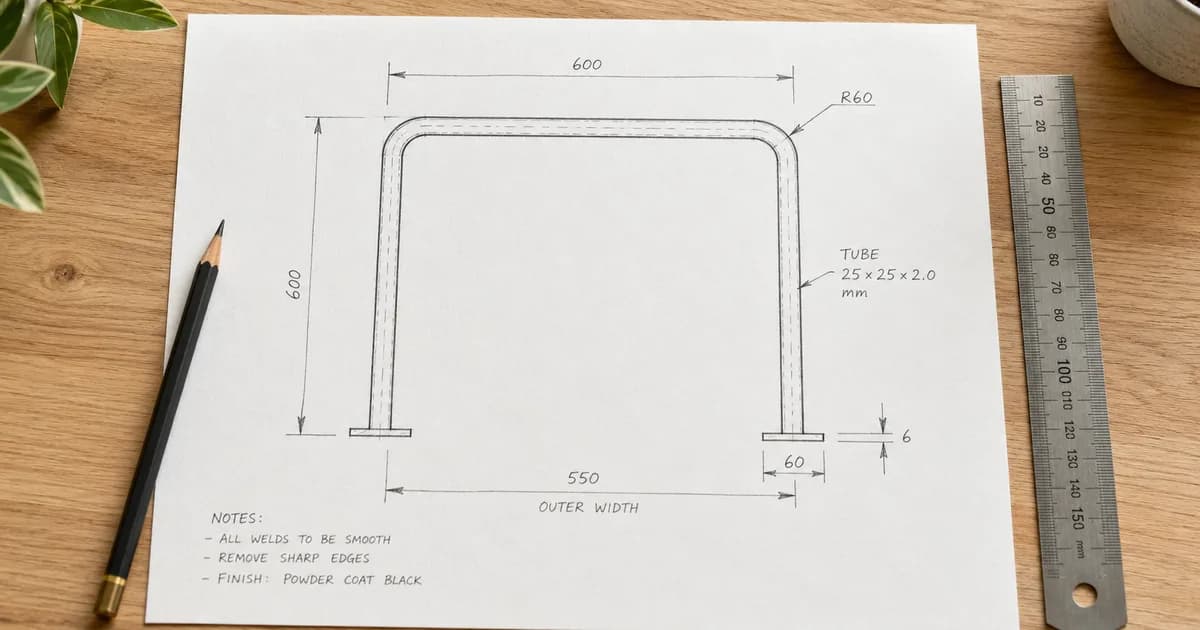
Step 1: Part Geometry
Provide a drawing or sketch with overall dimensions and the shape geometry. DXF format is preferred if you have CAD. A dimensioned PDF or even a clear hand sketch with measurements works as a starting point. For perimeter frames and U-shapes, specify the outer dimensions, strip width, and which edge(s) are open. For holes or slots, include position from reference edges.
Step 2: Adhesive Specification
Specify: transfer tape or backed tape; adhesive chemistry (acrylic recommended for acid-free applications); acid-free requirement (yes/no); permanent or repositionable bond; approximate total tape thickness if known. If you are unsure of the adhesive specification, describe your substrate materials (paper, plastic film type, metal, fabric) and your application environment — temperature, humidity, UV exposure — and the converting team will recommend the appropriate material.
Step 3: Quantity and Delivery Format
Provide a prototype quantity (typically 100–500 pcs for first-article sampling) and your target production volume per order run. Specify how you want parts delivered: kiss-cut on a liner roll for automated or semi-automated peel-and-place, sheeted (parts on individual liner sheets), or individually cut and bagged. Kiss-cut on a roll is the most common production format — the operator peels one part at a time without touching the adhesive face.
You do not need a formal engineering drawing to start. A video showing your current manual assembly process — or a link to your product — provides enough context for a converting team to understand the geometry and application. From that starting point, the converter formalizes the drawing, proposes the adhesive, and confirms for your approval before cutting tooling.
Prototyping, Sampling, and MOQ
Custom die-cut adhesive tape projects follow a standard process from first contact to production delivery.
- Engineering review (1–3 business days): the converter reviews your drawing and flags any tolerance, geometry, or material concerns before committing to tooling
- Tooling creation: a flatbed die tool is fabricated from your confirmed geometry — typically 5–10 business days for a new tool
- First-article samples: a small quantity (typically 100–500 pcs) is cut from the production tool and shipped for your application testing
- Approval and revision: you test the samples in your actual assembly process and confirm fit, adhesion, and coverage — geometry or adhesive changes are resolved before the production run
- Production run: confirmed geometry runs to your full order quantity and ships on the agreed lead time
For custom die-cut adhesive transfer tape in quantities of 3,000–10,000 units, flatbed die cutting is the standard process. Minimum order quantities vary by material and shape complexity, but most converters will run prototype quantities of 100–500 pcs to confirm the design before committing to production volume. Always run samples in your assembly process before approving production — adhesive performance on your specific substrate is the only validation that matters.
Tooling cost is a one-time investment tied to the die geometry. Once a tool is made, subsequent production runs do not require new tooling unless the shape changes.
Frequently Asked Questions
What is adhesive transfer tape and how is it different from double-sided tape?
Adhesive transfer tape (ATT) is adhesive only — there is no carrier film between the two bonding surfaces. When applied, the adhesive transfers from a release liner to the substrate, leaving only a thin, invisible adhesive layer. Double-sided tape has a carrier film (polyester, foam, paper, or non-woven) that remains in the bond. Transfer tape is preferred when bond thickness must be minimal and the adhesive should be invisible; backed double-sided tape is used when gap-filling, conformability, or higher peel strength from a thicker construction is required.
Can adhesive transfer tape be die-cut to custom shapes?
Yes. Adhesive transfer tape cuts cleanly on both flatbed and rotary die cutting equipment. Custom shapes — frames, U-shapes, perimeter strips, discs, slots, complex geometries — are produced from your drawing and delivered kiss-cut on a liner for peel-and-place application. Standard flatbed tolerance is ±0.1–0.2 mm.
What does acid-free mean in adhesive tape?
Acid-free means the adhesive contains no acidic compounds and has a neutral or alkaline pH. Rubber-based adhesives use resin systems that can off-gas and degrade paper, photographs, and organic materials over time. Acrylic adhesives are inherently acid-free and archival-safe. For scrapbooking, photo mounting, archival framing, and any product assembly where long-term substrate integrity matters, specify an acrylic adhesive transfer tape — it will not yellow, off-gas, or chemically degrade the materials it bonds.
What tolerance can I expect on a custom die-cut adhesive shape?
Standard flatbed die cutting of adhesive film and transfer tape holds ±0.1–0.2 mm (±0.004–0.008"). Rotary die cutting typically holds ±0.2–0.3 mm at higher volumes. Material thickness and flexibility affect the achievable tolerance: thinner, more flexible films may require ±0.3 mm. For most product assembly applications the functional tolerance needed is much wider than what die cutting achieves, so dimensional accuracy is rarely a limiting factor.
What is the minimum order quantity for custom die-cut adhesive tape?
MOQ varies by material, shape complexity, and supplier, but most converters will produce prototype quantities of 100–500 pcs for first-article sampling and design validation before committing to production volume. Production MOQs for custom flatbed die-cut transfer tape typically start around 1,000–3,000 pcs depending on part size and tooling cost. Tooling is a one-time cost — subsequent runs do not require new tooling unless the geometry changes.
Request Custom Die-Cut Adhesive Tape Samples
ALS Tape converts adhesive transfer tape and double-sided tape into precision die-cut shapes from our Xiamen facility. We support quantities from prototype through production runs, and work from your drawing, sketch, or product sample. Acid-free acrylic transfer tape available. Send your geometry, adhesive requirement, and target quantity — we respond within one business day.
Contact ALS Tape