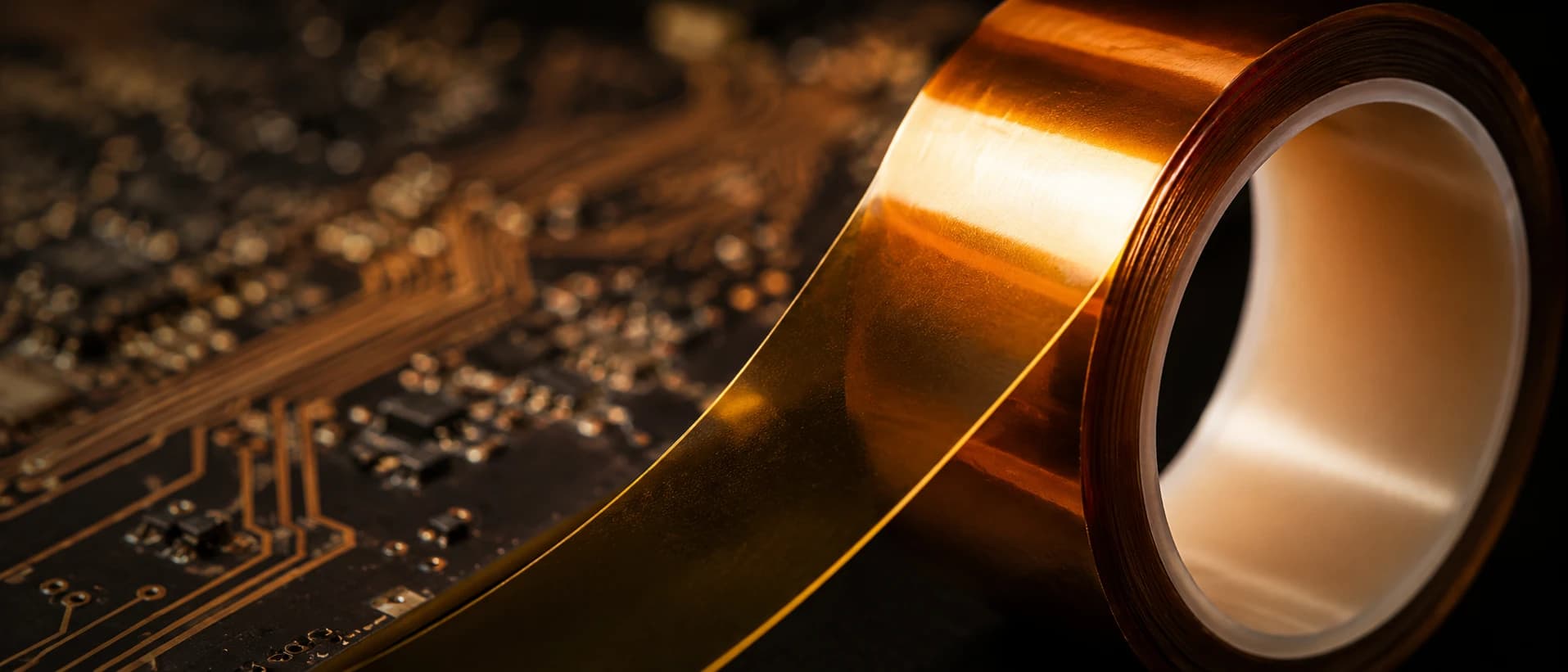
For engineers and procurement teams specifying high-temperature insulation tape: this guide covers what Kapton tape is and how it compares to generic polyimide tape, the thermal and electrical properties that drive its use across electronics, aerospace, and EV manufacturing, how to choose between silicone and acrylic adhesive variants, and when custom die-cut polyimide shapes reduce assembly cost versus cutting from roll stock.
What Is Kapton Tape?
Kapton is a registered trademark of DuPont for a family of polyimide films first developed in the 1960s. In tape form, the amber polyimide film is coated with a pressure-sensitive adhesive — typically silicone or acrylic — and supplied in rolls or as die-cut shapes.
The generic term is polyimide tape: all Kapton tape is polyimide tape, but polyimide tape is not exclusively Kapton. Many manufacturers produce polyimide tape to the same performance specification without licensing the DuPont name. In practice, engineers often specify 'Kapton tape' when they mean any high-temperature polyimide tape meeting the relevant thermal and electrical requirements.
Two properties define its industrial value: thermal stability across a far wider range than competing film materials, and high dielectric strength that holds through the same extreme temperatures. Both properties stem from the polyimide polymer backbone — one of the most thermally stable organic polymer structures available.
Kapton Tape Properties
The performance profile of Kapton and equivalent polyimide tape is defined by four properties that together make it uniquely suited to demanding thermal and electrical environments.
Thermal Stability
Polyimide tape maintains its mechanical and electrical properties from -75°C to +260°C in continuous service. Short-duration exposure tests show the film itself functional at temperatures as low as -269°C (cryogenic) and as high as +400°C — well beyond the continuous service limit of the adhesive layer. For process applications such as reflow soldering (peak 260°C) and powder coat curing (180–200°C), no other commodity tape material survives the full cycle without adhesive failure or film deformation.
Electrical Insulation
Dielectric strength for standard 0.1 mm polyimide tape (film plus silicone adhesive) is approximately 6.5 kV. The insulation resistance holds through thermal cycling — unlike many films where elevated temperature accelerates resistivity decay. This makes polyimide tape the standard choice for PCB component masking during soldering, motor winding slot insulation, and battery cell wrapping where the insulation must survive assembly process temperatures.
Chemical Resistance
Polyimide film resists most solvents, fuels, flux residues, and the cleaning chemicals used in electronics manufacturing. The silicone adhesive variant additionally resists aerospace fluids and silicone-based release agents. Acrylic adhesive shows better resistance to polar solvents and aqueous cleaning agents.
Dimensional Stability
Polyimide film has a low coefficient of thermal expansion (approximately 20 ppm/°C) and retains its tensile strength through repeated thermal cycling. For masking applications, dimensional stability means the tape edge stays accurately registered across the full soldering or curing process cycle — preventing adhesive bleed and mask-edge lift that occurs with less stable films.
Silicone vs. Acrylic Adhesive — Which Do You Need?
Polyimide tape is available with two adhesive systems. The choice is driven primarily by process temperature and whether clean removal is required.
Silicone Adhesive
Silicone adhesive is the standard choice for high-temperature applications. It remains stable from -73°C to +260°C, matches the full continuous service range of the polyimide film, and releases cleanly without residue after extended high-temperature exposure. For PCB gold finger masking, avionics component insulation, and any application where adhesive residue on the substrate is unacceptable, silicone adhesive is the correct selection.
The tradeoff: silicone adhesive has lower initial tack than acrylic at room temperature. It is not a high-grab adhesive and is intended for temporary masking and protection rather than permanent bonding.
Acrylic Adhesive
Acrylic adhesive offers higher initial tack and better resistance to polar solvents and aqueous cleaning agents. It performs well up to approximately 175°C — adequate for standard powder coat cure cycles (160–180°C) and 3D printing build surface applications. Above 180°C, acrylic adhesive begins to degrade; for reflow soldering profiles reaching 250–260°C, silicone adhesive is mandatory.
Acrylic adhesive is generally the more economical option and is preferred when strong initial adhesion to a substrate is required and the process temperature does not exceed 175°C.
The selection rule is straightforward: if the peak process temperature exceeds 175°C, or if the tape will be removed and the substrate must be residue-free, specify silicone adhesive. For applications below 175°C where strong initial tack is needed, acrylic adhesive is appropriate.
Kapton Tape Applications by Industry
Polyimide tape serves across electronics manufacturing, aerospace, automotive, and industrial assembly wherever a material must combine high-temperature performance with electrical insulation.
Electronics and PCB Manufacturing
- PCB gold finger masking during wave soldering and selective HAL — the tape withstands the solder bath and reflow oven cycle, then removes cleanly without flux contamination or pad damage
- SMD component and solder pad protection during multi-stage assembly — applied before a process step, peeled after without disturbing adjacent components
- Battery cell wrapping and pouch-cell edge insulation — maintains dielectric integrity through charging cycles and thermal excursions
- Transformer and capacitor coil winding inter-layer insulation — Class H rated, survives continuous service at motor operating temperatures
Aerospace and Defense
- Wire harness and cable bundle wrap — lightweight, dimensionally stable, rated for the altitude temperature range from ground-level heat to stratospheric cold
- Avionics board component masking and conformal coating dam tape
- Satellite multilayer insulation (MLI) construction — polyimide film is used in crewed and uncrewed spacecraft due to its stability in vacuum and radiation environments
Automotive and EV
- Under-hood wire insulation and connector masking during e-coat and paint baking at 160–190°C
- EV battery module cell-to-cell barriers and module insulation — PI film is a common choice for flat insulation layers inside battery packs due to its thermal and dielectric performance
Custom Die-Cut Polyimide Tape Shapes
Roll stock is the standard supply form for polyimide tape, but for production assembly applications, custom die-cut shapes reduce per-unit labor cost, eliminate manual cutting scrap, and ensure dimensional consistency across every part.
Polyimide film cuts cleanly on both rotary and flatbed die cutting equipment. Standard achievable tolerance is ±0.1–0.2 mm for flatbed die cutting, covering most electronics and industrial assembly requirements. Rotary die cutting supports high-volume strip and pad formats; flatbed is preferred for complex geometries, tight hole-position requirements, and prototype quantities.
- PCB masking pads — exact footprint of a connector or gold-finger strip, delivered kiss-cut on liner for line application
- Motor slot liner strips — cut to exact stator slot width and depth for winding insulation
- Battery cell wrapping strips — slit to exact cell height with die-cut notches where electrode tabs exit the wrap
- Connector cover pads — shaped to cover specific connector body areas during conformal coating, peeled off cleanly after cure
- Punched insulation patches — disc, ring, or custom-profile insulators for SMD assembly and transformer builds
For production volumes, kiss-cut delivery — die-cut parts remaining on a release liner carrier — allows hand or automated peel-and-place application at the assembly line without individual part handling. For prototype validation, loose die-cut parts confirm fit and coverage before committing to production tooling.
How to Specify the Right Polyimide Tape
Three decisions define a polyimide tape specification: adhesive type, film thickness, and supply format.
Step 1: Adhesive Type
Determine the peak process temperature the tape will encounter. If it exceeds 175°C, or if clean removal without residue is required, specify silicone adhesive. For applications below 175°C where strong initial tack is needed, acrylic adhesive works and is typically lower cost.
Step 2: Film Thickness
Standard thicknesses range from 25 μm (ultra-thin, flexible, used for fine masking and lightweight insulation builds) to 50 μm (general-purpose, the most common specification) to 125 μm (structural insulation, motor slot liners requiring physical protection alongside dielectric performance). Thicker film increases puncture and tear resistance; thinner film conforms better around tight radii and reduces the step height at tape edges on PCB surfaces.
Step 3: Supply Format
Roll stock — standard widths or custom slit widths — suits lab, prototype, and low-volume use where operators cut parts by hand. For production assembly where parts are applied repetitively at a line, die-cut shapes reduce labor time and part-to-part variation. Kiss-cut parts on a liner carrier are the preferred production format: the operator or machine peels one part at a time without touching the adhesive face.
Frequently Asked Questions
Is Kapton tape the same as polyimide tape?
Kapton is DuPont's registered trademark for polyimide tape. Generic polyimide tape is made from the same polyimide film with silicone or acrylic adhesive and performs to the same thermal and electrical specification. All Kapton tape is polyimide tape; polyimide tape is not exclusively Kapton. Engineers commonly use 'Kapton tape' to mean any high-temperature polyimide tape meeting the relevant performance requirements.
What temperature can Kapton tape withstand?
Standard polyimide tape with silicone adhesive is rated for continuous service from -75°C to +260°C. Short-duration exposure tests show the polyimide film functional at extremes down to -269°C and up to +400°C. The adhesive layer defines the practical service limit: silicone adhesive holds to +260°C with clean removal; acrylic adhesive is limited to approximately +175°C before degradation begins.
What is Kapton tape used for in electronics?
The primary electronics applications are PCB masking during wave soldering and reflow (protecting gold fingers, pads, and connectors from solder and flux while surviving the full thermal profile), battery cell wrapping and pouch-cell edge insulation, motor winding slot insulation, and custom die-cut insulation patches for SMD component and transformer builds. In all cases the tape is valued for maintaining its electrical insulation properties through the process temperatures involved.
Which adhesive is better for PCB masking — silicone or acrylic?
Silicone adhesive is the standard choice for PCB masking. It withstands reflow and wave soldering temperatures up to 260°C peak without adhesive breakdown and releases cleanly without residue on gold fingers, connector contacts, or solder pads. Acrylic adhesive is limited to about 175°C and may leave residue above that temperature — it is not recommended for reflow soldering applications.
Can Kapton tape be die-cut to custom shapes?
Yes. Polyimide film cuts cleanly on both rotary and flatbed die cutting equipment. Typical tolerances are ±0.1–0.2 mm on flatbed die cutting — sufficient for PCB masking shapes, motor slot liners, battery cell wrapping strips, and connector cover pads. For production volumes, kiss-cut delivery places parts on a release liner for peel-and-place application at the assembly line.
Request Polyimide Tape in Roll or Die-Cut Format
ALS Tape supplies PI film and polyimide tape in standard roll widths, custom slit widths, and precision die-cut shapes from our Xiamen converting facility. Send your film specification, shape requirements, and application environment — we support quantities from prototype through production.
Contact ALS Tape