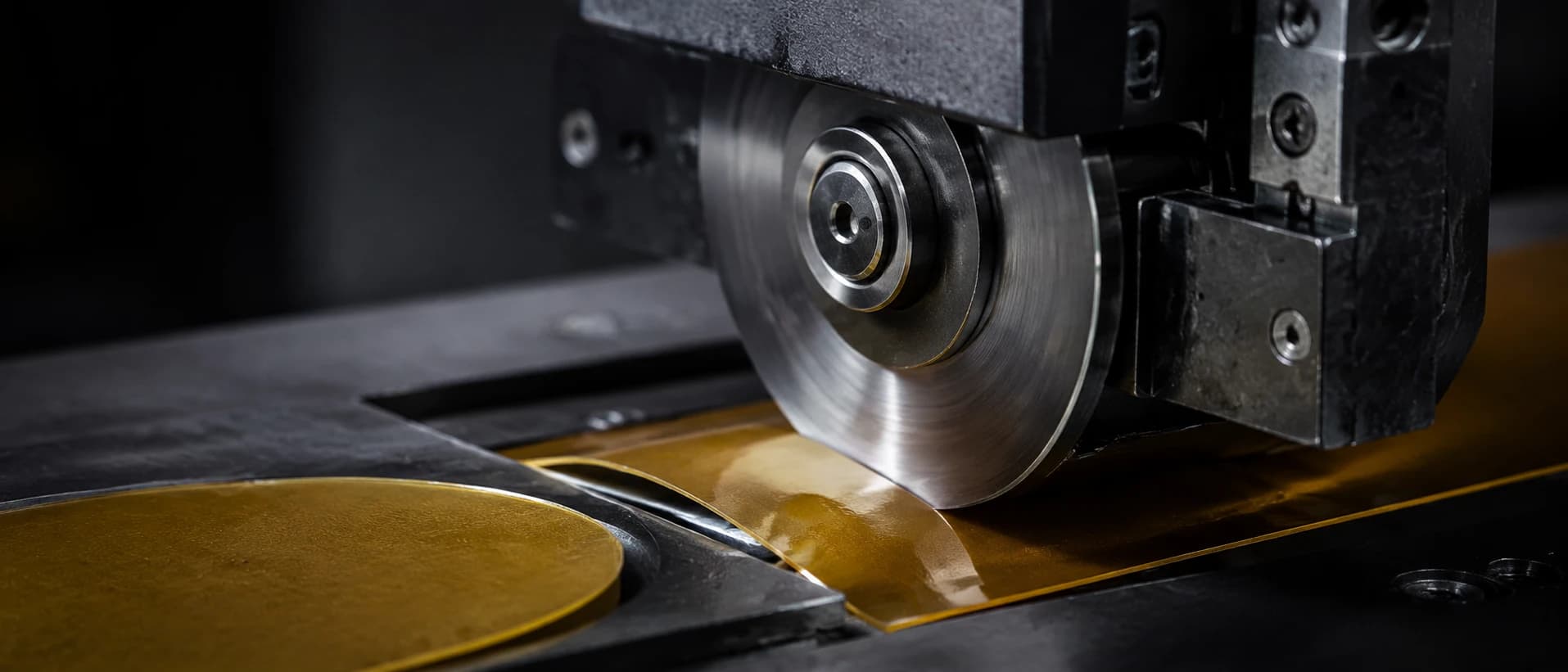
For engineers, procurement teams, and product designers sourcing precision die-cut components: this guide covers how industrial die cutting works — process selection, tolerances by material, and what to prepare when submitting a project for quoting. Die cutting converts adhesive tape, film, foam, and rubber into precise custom parts — gaskets, pads, frames, and strips — that fit directly into an assembly without hand-cutting at the production line.
What Is Die Cutting?
Die cutting is a manufacturing process that uses a hardened steel die — shaped to the required part geometry — to cut sheet or roll material into repeatable parts. The die is pressed into the material under controlled force, cutting cleanly through the full stack or stopping at a controlled depth.
In adhesive tape and film converting, die cutting produces geometry-specific parts from continuous roll material. A single production run yields hundreds or thousands of identical parts, each within tight dimensional tolerances, without manual cutting or waterjet routing.
The key advantage over hand-cutting is dimensional consistency: once a die is made, every part from that run is identical within the tooling tolerance, eliminating the variation that comes from cutting by hand at the line.
- Adhesive pads and squares for bonding and structural assembly
- Gaskets and seals with holes, slots, and complex flange profiles
- Window frames and aperture masks for displays and optical sensors
- Kiss-cut parts on a release liner for peel-and-stick line application
- Continuous strip and roll format for automated pick-and-place dispensing
Die Cut vs Kiss Cut — What Is the Difference?
Die cut and kiss cut describe two different cut depths — not two different machines. The distinction determines whether the liner or backing is cut through along with the part.
Die Cut (Full Cut)
The steel die cuts entirely through the material stack, including the release liner or backing. The result is a free-standing part, fully separated from the web. Die-cut parts are handled individually and packaged in bags, trays, or individual pouches for bulk shipment.
Full die cutting is preferred when the part is applied with tooling or fixtures rather than by hand, when no liner is needed in the final assembly, or when the part is thick enough that a liner carrier is not practical.
Kiss Cut
The blade cuts through the face material and adhesive layer but stops at the liner — the liner remains intact as a carrier. The part stays on the liner and is peeled away during use. Kiss cutting is the preferred format when parts will be applied by hand on an assembly line or by automated peel-and-apply equipment.
A common production format is a kiss-cut strip: a release liner carries multiple pads in a row, each separated from adjacent parts but remaining on the liner for organized dispensing. The operator or machine peels one part at a time, reducing handling errors compared to loose individual parts.
Kiss cutting also allows multiple part geometries to be nested on a single liner sheet — enabling kitting, where a set of different parts for one assembly is delivered together on one sheet.
Rotary vs Flatbed Die Cutting — How to Choose
Two machine types dominate tape and film die cutting. The right choice depends on material thickness, geometry complexity, volume, and required tolerance.
Rotary Die Cutting
Rotary die cutting uses a cylindrical die that rotates continuously against a backing anvil. Material feeds through in a continuous web, which makes it the faster process — well suited to high volumes, continuous strip output, and roll-to-roll converting.
- Suited for: thin tapes and films (under 3 mm), simple to moderately complex shapes, high production volumes
- Typical tolerance: ±0.2–0.3 mm for most adhesive tapes; ±0.15 mm with precision tooling
- Output: continuous strip, roll, or sheeted at the press
Flatbed Die Cutting
Flatbed die cutting uses a flat die board pressed down in a stamping action. Material is fed in sheets or indexed in a stop-and-go motion. Slower than rotary, but better suited to complex geometry, thick materials, multi-layer stacks, and tighter tolerances.
- Suited for: gasket rubber and foam above 3 mm, complex shapes with close-tolerance hole positions, prototype and small-run quantities
- Typical tolerance: ±0.1–0.2 mm on precision flatbed; ±0.1 mm achievable for PTFE and PORON foam
- Output: individual sheets or parts; compatible with multi-layer stacked cutting
For most B2B tape and film applications, the converting supplier will recommend the process based on the material, geometry, and volume. If your part is a simple shape in a thin tape and you need high volume, rotary is the natural choice. If the geometry has tight hole-position requirements, the material is thick foam or rubber, or you need prototypes before committing to hard tooling, start with flatbed.
Precision Tolerances in Die Cutting
Tolerance in die cutting is controlled by three factors: die quality, material behavior, and process type. Understanding which dimensions are critical — and which are not — has a direct effect on tooling cost.
Typical Tolerances by Material Class
- Thin adhesive tapes and transfer films (<0.5 mm): ±0.1–0.2 mm flatbed, ±0.2–0.3 mm rotary
- Acrylic foam tape (VHB-type, 0.5–3 mm): ±0.2–0.3 mm; foam compression under the die affects consistency
- PORON microcellular PU foam: ±0.1 mm achievable on precision flatbed — best-in-class for foam
- Silicone and EPDM rubber sheet (1–6 mm): ±0.15–0.25 mm; spring-back must be compensated in die design
- PTFE sheet: ±0.1 mm on precision flatbed — cuts cleanly with minimal spring-back
What Controls Tolerance
Material spring-back is the primary variable for rubber and foam: the material compresses during cutting and recovers after, shifting the cut dimension. Dies are designed with a spring-back offset built into the geometry based on material durometer and thickness.
Adhesive flow at cut edges affects fine-geometry parts — at room temperature, pressure-sensitive adhesive can smear slightly at the cut face. Cold-temperature die cutting (chilled tooling or pre-cooled material) reduces smear for critical edge-quality applications.
Liner and face material stretch compatibility matters in rotary processes — if the liner and face material have different elongation characteristics, registration error accumulates across the web. Web tension control and matched liner selection address this.
When specifying tolerance, distinguish critical from non-critical dimensions. A hole position in an electronics enclosure gasket may be critical to ±0.1 mm; the outer profile of the same gasket may be acceptable at ±0.3 mm. Calling out only the critical dimensions avoids over-tolerancing, which drives unnecessary tooling cost.
Materials That Can Be Die Cut
Die cutting is compatible with a wide range of adhesive tape, film, and elastomer materials. The material family determines process selection, tooling type, and achievable tolerance.
Adhesive Tapes and Transfer Films
- Acrylic foam tape (VHB-type): flatbed preferred — the foam layer compresses under rotary pressure, affecting consistency
- Transfer adhesive tape: thin, rotary die cutting at high volume; kiss-cut strip is the standard output format
- Double-coated tissue tape: rotary for simple shapes; flatbed for precision geometry
- Polyimide (Kapton) tape: cuts cleanly on both rotary and flatbed; used for PCB masking shapes, flex circuit patterns, and high-temperature assembly parts
Films and Functional Materials
- PET, PEN, and PE protection film: rotary for thin gauges; flatbed for precision profiles and complex cut-outs
- Thermal interface materials (graphite sheets, phase-change pads): rotary for thin formats; flatbed for precision heat-sink pad geometry
- EMI shielding fabric and foil tape: rotary for simple shapes; flatbed for connector cut-outs and complex shield geometries
Foam and Rubber Gasket Materials
- PORON PU foam: flatbed preferred — cuts cleanly with minimal compression set on the cut face; best tolerance of any foam
- Silicone foam and rubber sheet: flatbed; silicone spring-back requires die offset compensation
- EPDM rubber sheet: flatbed for gasket profiles; rotary for thin strip seals
- Nitrile (NBR), Viton (FKM), neoprene: flatbed; hardness and compound affect achievable tolerance
- PTFE sheet: flatbed with precision tooling; low friction requires higher blade sharpness
Die Cutting Within a Converting Workflow
Die cutting is often one step in a broader converting sequence that includes slitting, lamination, and custom packaging. The order of operations affects material behavior and final part quality.
- Laminate then die cut: a thermal interface pad is laminated with a protective liner, then die cut to the exact heat-sink geometry — delivered as individual pads on a release liner ready for assembly
- Die cut then laminate: foam sheet is die cut to a gasket profile first, then a PSA layer is laminated on — simpler than die cutting through an adhesive layer, and useful when adhesive bond geometry differs from the foam profile
- Slit then rotary die cut: a wide master roll is slit to working width in a first pass, then rotary die cut to final pad or strip geometry — combining two operations reduces handling and improves registration
- Multi-layer stacked die cut: two or more material layers are stacked and cut in a single flatbed press stroke — used for laminated gaskets where each layer requires the same hole pattern
Understanding the converting sequence matters for specification: a part described as 'die-cut foam gasket with PSA on one face' may be produced by either laminate-then-cut or cut-then-laminate, and the two sequences produce slightly different edge conditions. If edge quality at the adhesive face is critical, specify it — the supplier will select the sequence that meets the requirement.
What to Provide When Requesting a Die Cut Quote
An accurate quote and lead time requires a clear part definition. The following information covers the minimum needed for a die cut project.
Drawing or Part File
DWG, DXF, or a dimensioned PDF with all critical dimensions called out. STEP files are accepted for reference geometry but 2D profiles are required for tooling. If no drawing exists, a physical sample with a dimension check sheet is a valid starting point for prototypes.
Material Specification
The specific material (tape series, foam grade, film type) or a performance description: temperature range, chemical exposure, substrate, adhesion level, and whether a liner is required. If the material is not yet decided, a converting partner can assist with selection based on the application.
Tolerance and Format
State which dimensions are critical and what tolerance is required. This determines whether soft tooling (lower cost, ±0.2–0.3 mm) or precision hard tooling (higher cost, ±0.1 mm) is appropriate.
Specify the output format: individual free-standing parts, kiss-cut on liner sheet, continuous strip roll, or packaged kit. Format affects tooling design, liner selection, and unit cost.
Volume and Lead Time
Prototype quantity (typically 50–500 pieces) and target production volume. Tooling cost is amortized differently at prototype versus production scale.
Soft tooling for first-article prototypes: typically 3–5 business days. Production hard tooling: 7–14 days depending on die complexity. Rush tooling is available at a premium for time-critical projects.
Frequently Asked Questions
What is the difference between die cut and kiss cut?
Die cutting cuts entirely through the material stack including the liner, producing free-standing loose parts. Kiss cutting stops the blade at the liner — the part stays on the liner carrier and is peeled away at use. Kiss cut is preferred when parts are applied by hand on an assembly line or by automated peel-and-apply equipment.
When should I choose rotary die cutting over flatbed?
Choose rotary die cutting for high-volume production of thin tapes and films (under 3 mm) with simple to moderately complex shapes. Choose flatbed when the material is thick foam or rubber (over 3 mm), the geometry has tight hole-position tolerances, or when you need prototypes before committing to production hard tooling.
What tolerances can die cutting achieve on adhesive tape?
Typical tolerances range from ±0.1 mm (precision flatbed for PTFE and PORON foam) to ±0.3 mm (rotary for standard adhesive tapes). The achieved tolerance depends on material type, thickness, process selection, and die quality. Only specify tight tolerances on critical dimensions — over-tolerancing increases tooling cost without functional benefit.
What information do I need to submit a die cut quote?
At minimum: a drawing or dimensioned file (DWG, DXF, or PDF), the material specification or a performance description, the required output format (loose parts, kiss-cut on liner, or strip roll), and the target quantity. If the material is not yet decided, a converting partner can assist with selection based on the application.
Can die cutting handle multi-layer or laminated material stacks?
Yes. Flatbed die cutting supports multi-layer stacked cutting — two or more material layers are positioned and cut in a single press stroke. This is used for laminated gaskets where each layer requires the same hole pattern. The converting sequence (laminate-then-cut vs cut-then-laminate) affects edge quality at the adhesive face.
Start a Die Cut Project with ALS Tape
ALS Tape operates rotary and flatbed die cutting from our Xiamen facility, supporting adhesive tapes, films, foams, and rubber sheet materials from prototype through production volumes. Send a drawing, a sample, or a description of your application to discuss material selection, tolerance, and converting options.
Contact ALS Tape