 1 / 6
1 / 63M VHB Tape — Structural Bonding & Die-Cut Conversion
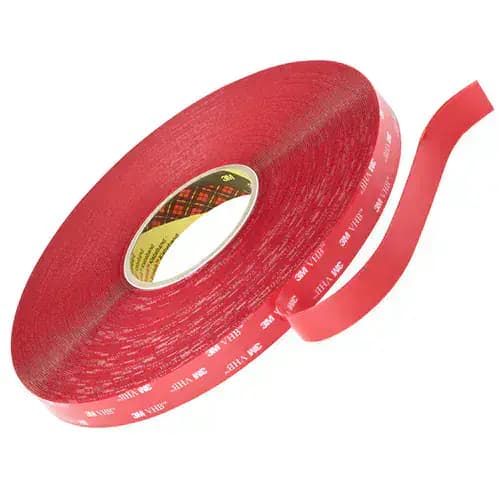
3M VHB tape for panel bonding, enclosure assembly, and trim attachment. Firm, conformable, and LSE grades. Slit rolls, sheets, and die-cut parts.
Construction
Double-coated closed-cell acrylic foam (4905 / 4910 are non-foam clear acrylic)
Thickness Range
10 mil to 120 mil depending on series
Temp. Resistance
70–150°C (160–300°F) continuous service; up to 230°C (450°F) intermittent for firm gray series
LSE Adhesion
Low (standard grades) · Med (multi-purpose / conformable) · High (LSE and modified acrylic grades)
Overview
ALS Tape supplies 3M VHB (Very High Bond) acrylic foam tape for panel bonding, enclosure assembly, trim attachment, glazing-related mounting, and converted adhesive parts. VHB is a double-coated closed-cell acrylic foam system built to replace screws, rivets, and visible hardware with a cleaner bond line that distributes stress across the full interface. The range covers firm, conformable, low-temperature, clear, modified acrylic, and low-surface-energy bonding directions so buyers can choose by substrate, bondline thickness, liner type, and converting format instead of treating VHB as one generic tape. ALS Tape supports model selection review, slit-roll supply, sheeting, lamination, and precision die-cut VHB parts for assembly-ready delivery.
Category Focus
3M Tape
Authorized distribution of 3M VHB, transfer, masking, electrical, and medical tape with custom converting support.
View source documentTypical Grades and Specification Direction
| Series / Model | Thickness | Adhesive Type | Liner | Profile | Typical Use |
|---|---|---|---|---|---|
| Firm Acrylic Foam | 10–120 mil | General Purpose or Multi-Purpose Acrylic | Red PE Film, DK Paper, or Clear Polyester | Dark gray (4611 / 4646 / 4655) or white / black variants (4914 / 4920 / 4929 / 4930 / 4945 / 4946 / 4949 / 4950 / 4955 / 4959). Higher short-term temperature resistance. | Panel bonding, stiffeners, industrial assemblies, trim fixation, and structural mounting on flatter rigid interfaces. Selected models carry UL 746C MH17478. |
| Conformable Acrylic Foam | 15–90 mil | General Purpose or Multi-Purpose Acrylic | Green PE Film, Red PE Film, DK Paper, or Clear PE Film | White (4618 / 4622 / 4624), gray (4919F / 4926 / 4936 / 4936F / 4941 / 4941F / 4956 / 4956F / 4979F / 4991). Better wet-out on curved and uneven surfaces. | Electronics housings, mixed-material joints, equipment panels, and applications where surface variation requires a more pliable foam core. |
| Clear Acrylic (Non-Foam) | 20–40 mil | General Purpose Acrylic | Red PE Film | 4905 / 4910 — transparent double-coated acrylic tape without foam core. | Decorative panels, transparent or light-colored assemblies, and mounting zones where bond line visibility matters. |
| Low Temperature Acrylic | 45–62 mil | Low Temperature Acrylic | Clear Polyester | 4943F / 4951 / 4957F — conformable or firm foam for cold-start bonding conditions. | Assemblies that need reliable bond build-up at lower application temperatures than standard grades support. |
| LSE & Modified Acrylic | 25–62 mil | Low Surface Energy or Modified Acrylic | DK Paper or Red PE Film | 4932 / 4952 (LSE) and 5925 / 5952 / 5962 (Modified Acrylic, very conformable black foam). High adhesion to low-surface-energy substrates. | Powder-coated metals, polypropylene, polyethylene, automotive trim, and mixed-material housings where standard acrylic grades may not bond reliably. |
Key Features
Replaces screws, rivets, and spot welds with a clean permanent bond line for assemblies where appearance, stress distribution, and vibration damping matter.
Firm acrylic foam grades (4611 / 4646 / 4655 gray; 4914 / 4920 / 4929 / 4930 / 4945 / 4946 / 4950 / 4955 / 4959 white and black) suit flatter rigid joints and structural mounting zones.
Conformable grades (4618 / 4622 / 4624 white; 4919F / 4926 / 4936 / 4936F / 4941 / 4941F / 4956 / 4956F / 4979F / 4991 gray and black) handle uneven surfaces and mixed-material assemblies more easily.
Specialized low-temperature and LSE-oriented series support coated surfaces, difficult plastics, and assemblies where standard acrylic systems struggle.
Selected series carry UL 746C file MH17478 and are often reviewed for electronics housings, appliance panels, and industrial equipment builds.
Available in log rolls, slit widths, sheets, laminated builds, kiss-cut constructions, and precision die-cut parts for direct production use.
What VHB Tape Is and Why Buyers Specify It
VHB tape is not just a generic double sided tape. It is an acrylic foam bonding system used when the assembly needs real load sharing, cleaner external appearance, and fewer fastening steps than screws, rivets, or welds.
Structural Bonding Logic
The foam core lets the bond line distribute stress across a wider area instead of concentrating force at drilled points. That helps reduce visible hardware, rattling, and stress cracking in thin panels.
Assembly Efficiency
VHB removes drilling, fastening, deburring, and secondary sealing steps. That matters on cosmetic panels, electronics housings, appliance trims, and fabricated subassemblies.
Cleaner Finished Appearance
Because the bond line sits inside the assembly instead of on the surface, VHB is often selected where visible hardware would interrupt design, branding, or sealing performance.
How to Compare VHB Tape Series
Firm vs. Conformable Foam
Firm grades suit flatter, more rigid interfaces. Conformable grades are easier to wet out on textured, curved, or dissimilar material surfaces.
Substrate Compatibility
Surface energy, paint systems, and plastic family all affect tape choice. LSE-oriented grades are often better for powder coats and polyolefin surfaces.
Temperature and Outdoor Exposure
For assemblies exposed to heat, UV, humidity, or cleaning chemicals, acrylic foam generally performs more reliably than standard mounting tapes.
Liner and Converting Readiness
If the tape must be kiss cut, laminated, or supplied as adhesive pads, the liner family, thickness, and foam profile should be chosen with converting in mind from the beginning.
Bondline Thickness
Thin transparent grades and thicker foam grades behave differently in gap filling, stress control, and installation feel. Thickness should be part of the first-round model comparison, not a later detail.
Model Table Reading Guide
Use the Series Group First
The model table groups VHB by foam behavior and adhesive direction. Start by narrowing to firm, conformable, low-temperature, clear, or LSE-oriented families before discussing exact part number.
Then Confirm Thickness and Liner
Once the bonding family is correct, thickness, liner style, and converting format become the next selection filters. Those choices affect installation feel, release behavior, and die-cut process stability.
Final Choice Should Match Assembly Conditions
Substrate type, coating, bond area, temperature exposure, and whether the part will be supplied in roll or die-cut form all influence the final model recommendation.
Available Formats and Converting Options
Log rolls and slit widths for standard production feed formats.
Sheeted material for manual assembly or lower-volume fabrication.
Rotary die-cut parts for windows, frames, bezels, and mounting pads.
Kiss-cut constructions and release-liner engineering for easier assembly handling.
Laminated multi-material builds when VHB is part of a larger gasket or enclosure stack.
Drawing-based review when the VHB layer must align with holes, frames, insulation films, or thermal materials.
Applications
Panel mounting and trim attachment in appliances, equipment, and commercial devices
Electronics enclosure bonding where clean appearance and simplified assembly are required
Automotive and EV component mounting, trim fixation, and mixed-material joining
Bonding to powder-coated metals and selected low-surface-energy plastics
Construction panels, decorative elements, and industrial glazing-related mounting
Precision die-cut adhesive pads, frames, and mounting strips for production assemblies
Related Solution Paths
FAQ
What is VHB tape?
VHB (Very High Bond) tape is a double-sided acrylic foam adhesive system from 3M designed to replace mechanical fasteners in structural bonding, panel mounting, and enclosure assembly. The closed-cell foam core distributes stress across the full bond area, allowing VHB to deliver cleaner joint lines and improved vibration resistance compared to screws, rivets, or spot welds.
What is VHB tape typically used for?
VHB tape is commonly used for industrial mounting, panel bonding, trim attachment, enclosure assembly, and adhesive parts that replace mechanical fasteners.
What is the difference between firm and conformable VHB tape?
Firm grades are better for flat, rigid joints and higher load support. Conformable grades handle uneven surfaces, curvature, and mixed-material interfaces more easily.
How do I choose the right VHB tape model?
Start with the substrate and joint condition, then compare foam behavior, thickness, liner type, temperature needs, and whether the tape must be supplied as a roll, sheet, or die-cut part.
Can VHB tape bond powder-coated metal or difficult plastics?
Certain VHB series are designed for lower-surface-energy substrates and coated surfaces. Final selection still depends on substrate type, finish, and assembly conditions.
Can ALS Tape supply VHB in die-cut parts?
Yes. ALS Tape can support slit rolls, sheets, laminated constructions, and precision die-cut VHB parts based on drawing, dimensions, or assembly format requirements.
Related Capabilities
Related Industries
Technical Guides
Need Pricing or Material Advice?
Align Material Selection and Converting Faster
Tell us your material, dimensions, and application. We can support sourcing, converting, and custom fabrication.