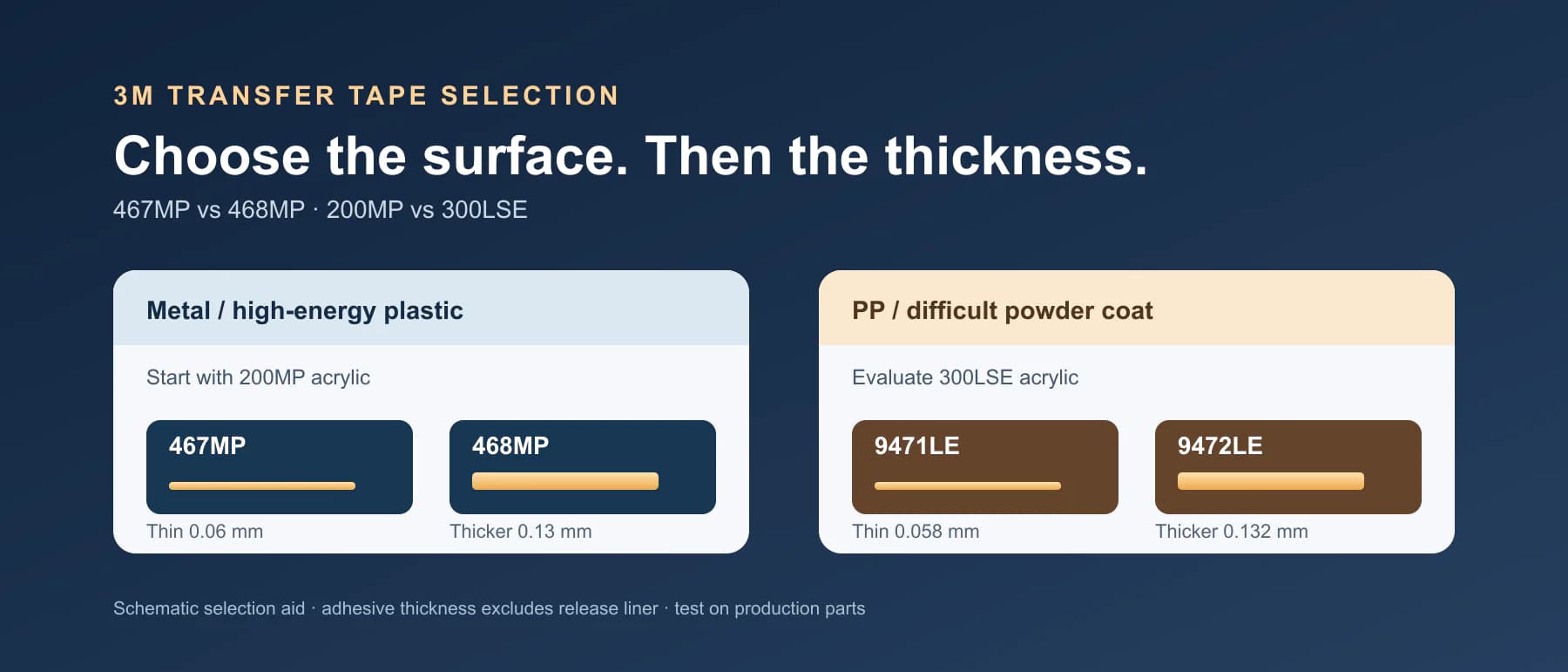
The 467MP vs 468MP decision is about thickness within the same 3M 200MP adhesive family. The 200MP vs 300LSE decision is about the surface the adhesive must wet. Choose the family for the actual contact surface first, then compare the thinner and thicker grades on production parts. This guide explains those two decisions, where the data-sheet figures apply and what to send when you need a die-cut part rather than a roll.
Which 3M Transfer Tape Should You Test First?
- Smooth metal or high-surface-energy plastic, with a tight bond-line limit: start by testing 467MP (200MP adhesive, 0.06 mm without liner).
- The same material pair with a less even contact surface: compare 468MP (the same 200MP adhesive family, 0.13 mm without liner).
- Polypropylene or a difficult powder-coated finish: test the 300LSE family, starting with thin 9471LE (0.058 mm) or thicker 9472LE (0.132 mm).
- Test on the actual production surfaces. A thicker layer may improve contact with texture, but it cannot correct an unsuitable adhesive family.
These are starting candidates, not guaranteed specifications. Both mating surfaces, any coating, application pressure and the service environment can change the outcome.
Are 467MP and 468MP Different Adhesives?
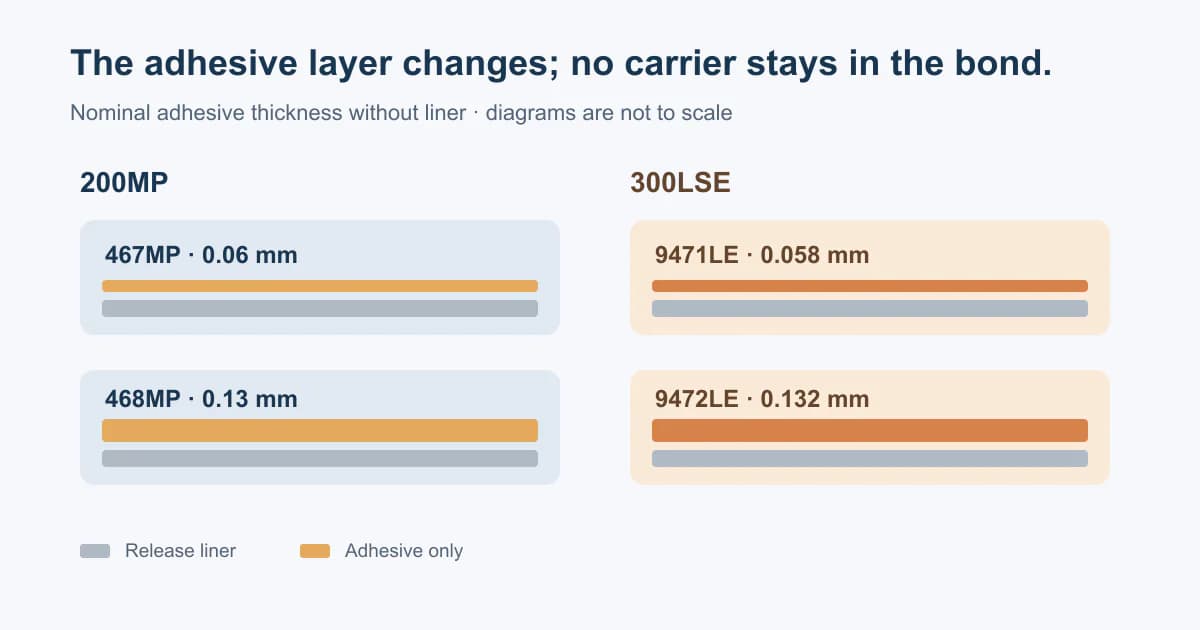
No. 467MP and 468MP are carrier-free adhesive transfer tapes in 3M's 200MP acrylic family. Their main construction difference is nominal adhesive thickness without the release liner: 0.06 mm for 467MP and 0.13 mm for 468MP. Both use a polycoated kraft paper liner. These are typical 3M data-sheet values, not purchase specifications.
For a smooth metal nameplate or flat graphic overlay with a tight bond-line limit, 467MP is the thinner starting point. For the same material pair with a slightly textured or less even face, compare 468MP because the thicker layer may make more contact. There is no universal roughness cutoff: coating chemistry, part stiffness, pressure and service loads all matter.
3M lists a higher 72-hour stainless-steel 90° peel value for 468MP than for 467MP under its stated test conditions. That does not prove 468MP will always hold better on your part, or that thickness alone will solve poor adhesion to a low-surface-energy plastic.
When Should You Switch from 200MP to 300LSE?
Switch the candidate adhesive family when the contact surface is difficult for 200MP to wet, particularly polypropylene or certain powder-coated finishes. 3M says 200MP does not readily adhere to low-surface-energy substrates and identifies 300LSE among the systems designed for them. The tape bonds to the paint on a coated metal part, not to the metal underneath.
The closest 300LSE thickness counterparts in this four-grade comparison are 9471LE at 0.058 mm and 9472LE at 0.132 mm, both measured without the liner. 3M describes adhesion to polypropylene and powder coats for these grades. A production coating can differ in texture, chemistry, cure or additives, so test the actual finish rather than treating every powder coat as equivalent.
3M also notes that aggressive 300LSE adhesive can be harder to slit or die-cut. If the part is a narrow frame, small tab or kiss-cut shape on a liner, discuss the intended converting and placement method while selecting the tape.
How Do the Four Grades Compare at a Glance?
Use the table to choose a test candidate by surface and bond-line thickness. It does not rank the four tapes by universal bond strength. Thickness values come from the individual 3M data sheets; the suggested starting surfaces follow 3M's adhesive-family guidance.
| Grade | Adhesive family | Typical thickness | First surface to evaluate | Selection question |
|---|---|---|---|---|
| 467MP | 200MP | 0.06 mm | Smooth metal or high-surface-energy plastic | Is the thin bond line enough? |
| 468MP | 200MP | 0.13 mm | The same materials with a less even surface | Does more thickness improve contact? |
| 9471LE | 300LSE | 0.058 mm | Polypropylene or a suitable powder-coated finish | Will a thin LSE-grade bond work? |
| 9472LE | 300LSE | 0.132 mm | The same difficult surfaces with more texture | Is a thicker LSE-grade layer needed? |
Temperature limits differ by adhesive family in the cited sheets: 200MP grades list up to 204 °C short term and 149 °C long term, while these 300LSE grades list 149 °C short term and 93 °C long term. The short- and long-term durations and test conditions matter; confirm the current grade-specific sheet against the full service profile.
Choosing between 200MP and 300LSE for a real assembly? Send the two surfaces and a drawing; we will check the grade and converting format before quoting.
Get a quote- Four grades compared using 3M data sheets
- Die-cut parts from 100 pcs
- Sample timing confirmed per drawing and material
- Roll, slit and die-cut formats
What Should You Test Before Approving a Substitute?
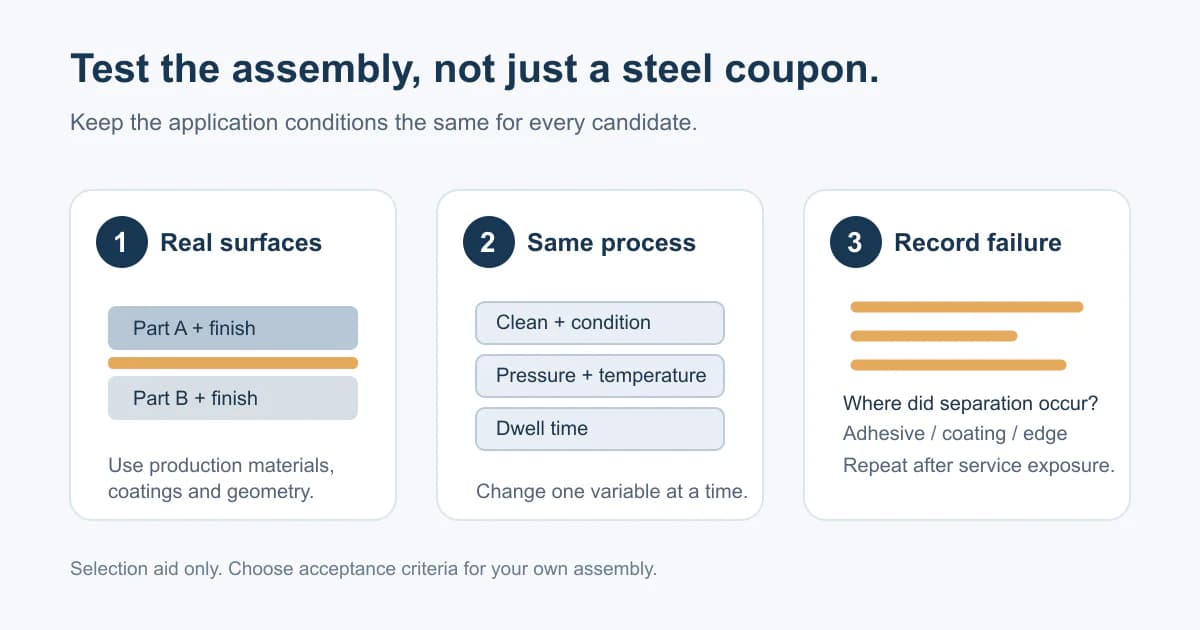
Test the real two-surface assembly, not only a steel peel coupon. Record the grade and finish on both faces, then apply every candidate with the same cleaning method, pressure, temperature and dwell time. 3M explains that pressure, time and temperature affect wet-out and bond build-up.
Use the actual part geometry. A narrow frame, corner or small tab can behave differently from a wide laboratory strip. Record whether failure occurs at the tape-to-surface interface, within the adhesive, or between a coating and its base material. Repeat after the heat, humidity or load exposure your assembly will see.
If the first test looks good but the edge later lifts, change one condition at a time and keep the results. This shows whether the problem is the adhesive family, insufficient contact, surface preparation or assembly stress.
What Should You Send for a Die-Cut Transfer-Tape Quote?
Send a drawing or sample, both substrate materials and finishes, the candidate grade if chosen, and the maximum bond-line thickness. Add dimensions, tolerance, adhesive-free areas, liner and placement preference, service exposure, order quantity and annual volume. These details let a converter quote a usable part rather than just a roll of tape.
ALS Tape can discuss 3M material supply and convert selected grades into slit rolls or die-cut parts, subject to grade and stock confirmation. Die-cut projects can start from 100 pieces. Straightforward sampling is typically planned in 3–9 days after requirements are confirmed; new tooling or material procurement can add time. We confirm the actual grade, availability, tooling and lead time for each project.
- Drawing: DXF, DWG, PDF, STEP or a sample part; include dimensions and tolerance.
- Bond: both contact surfaces and finishes, application pressure, service temperature, moisture or chemicals.
- Delivery: roll, slit width, loose pieces, sheets or kiss-cut parts on liner; manual or machine placement.
- Commercial details: prototype quantity, production order size, annual volume and target delivery date.
Frequently Asked Questions
Can 468MP replace 467MP without retesting?
No. They share 200MP chemistry, but the thicker bond line can change fit and assembly behavior. Check clearance, liner handling and adhesion on the actual parts.
Is 300LSE always stronger than 200MP?
There is no universal ranking from the family names. 300LSE is designed for a wider range of low-surface-energy surfaces. Compare candidates on the same substrate with the same test method and dwell time.
Does thicker 200MP solve bonding to polypropylene?
Thickness can help contact with texture, but it does not remove the low-surface-energy challenge. Test a 300LSE candidate or another system intended for the actual polypropylene grade.
Are these double-sided tapes?
They are carrier-free adhesive transfer tapes supplied on release liners. After application, adhesive remains between the surfaces without a film or tissue carrier. A double-coated tissue or film tape has a carrier that stays in the bond.
Need 3M Transfer Tape Cut to Your Drawing?
Tell us the two contact surfaces, the grade you are considering, the part geometry and quantity. We can discuss material and converting format, then confirm availability and a project-specific quote.
Just your email and what you need. Drawing optional. Stock material samples are free.