A gasket fails in one of two ways: the wrong material for the environment, or the right material compressed the wrong amount. Neither is a cutting problem — which is why choosing a die cut gasket starts with the sealing requirement, not the shape. This guide walks through how gaskets and seals differ, when die cutting beats molding, how to select between silicone, PORON, EPDM, neoprene, and PTFE, the four properties that decide whether a gasket actually seals, and what changes when the part is supplied with adhesive backing.
What Die Cut Gaskets Are — and How They Differ From Seals
A die cut gasket is a gasket cut from sheet or roll stock using a shaped die, rather than molded in a cavity or cut one at a time. The material arrives at the converter as a flat sheet — silicone sponge, PU foam, EPDM rubber, PTFE — and leaves as finished parts with the outline, bolt holes, and internal cutouts already in place. The defining characteristic is that the profile is essentially two-dimensional: a flat cross-section with a shape cut into it.
Gaskets and seals get used interchangeably in conversation, but the distinction matters when specifying. A gasket sits between two static, bolted or clamped surfaces and seals by being compressed between them — an enclosure lid, a flange, a housing joint. A seal generally handles a dynamic interface where something moves: a rotating shaft, a sliding rod. Almost everything a die cutter produces is a static gasket, and static sealing is a compression problem.
That is the point most often missed: a gasket seals because it is squeezed, not because it sticks. The material must be soft enough to conform to the surface finish and any flatness error in the mating parts, resilient enough to stay compressed for the service life, and stable enough not to be attacked by whatever it is sealing against. Every material decision below comes back to those three requirements.
Die Cutting vs. Molding, Waterjet, and Extrusion
Die cutting is not always the right way to make a gasket. It wins on a specific combination — flat profiles, moderate to high volumes, and materials available in sheet form — and loses clearly outside that envelope. Knowing where the boundary sits avoids paying for the wrong process.
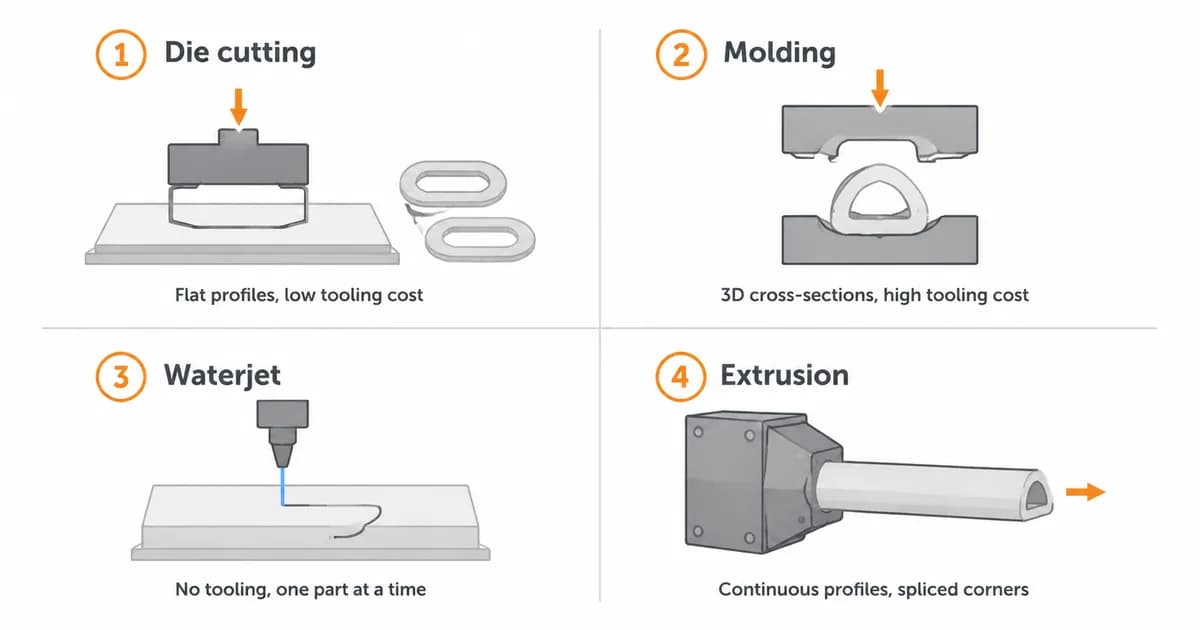
- Die cutting: a shaped steel-rule or rotary die cuts the profile from sheet stock. Tooling is inexpensive and fast to produce, per-part cost drops sharply with volume, and any flat profile with holes and cutouts is straightforward. Limited to a constant cross-section — the part is as thick as the sheet.
- Molding (compression or injection): the gasket is formed in a cavity, so the cross-section can vary — bulb seals, lips, ribs, three-dimensional geometry. Tooling is a significant investment with a long lead time, which is only recovered at high volume. The right answer when the seal geometry itself does the work.
- Waterjet cutting: no tooling at all, so a single prototype costs almost nothing to make. Good for thick stock and one-off or very low volumes, but cutting is sequential rather than parallel, so per-part cost stays flat as volume grows — the opposite of die cutting's economics.
- Extrusion: produces a continuous profile — hollow, D-shaped, P-shaped — cut to length and joined at the corners. The choice for door and cabinet perimeter seals, where a spliced or vulcanized corner is acceptable and a one-piece flat gasket would be wasteful.
Choosing Gasket Material by Sealing Requirement
Material selection is driven by four questions asked in order: what is the temperature range, what is it exposed to (weather, oil, chemicals, water), how much closure force is available, and how long must it stay compressed. Answer those and the shortlist is usually two materials, not ten.
Silicone — Sponge and Solid
Silicone is the default when temperature range and weathering matter. Solid silicone rubber and closed-cell silicone sponge (BISCO and equivalents) both hold up across a wide service range — roughly −55 °C to +200 °C continuous for common grades, with specific compounds rated higher — and they resist ozone, UV, and weather almost indefinitely. Compression set is low, so the gasket recovers rather than taking a permanent dent.
Sponge silicone is the usual choice for enclosure sealing because it seals at low closure force, which matters when the lid is held by a handful of screws and the housing can flex. Solid silicone needs more force but handles higher pressures and gives a firmer stop. The main limitation is petroleum oils and fuels, where silicone swells — a nitrile or fluoroelastomer is the answer there. UL 94 flame-rated and FDA-compliant grades are widely available when the application requires them.
PORON Microcellular Polyurethane
PORON is not a rubber but a microcellular urethane foam, and its distinguishing property is exceptionally low compression set: it can be held compressed for long periods and still recover, which is why it is used for gaskets that must stay sealed for years without re-torquing. Its force-deflection curve is gentle, so it seals against very low closure force and does not distort thin plastic housings or displays.
The trade-off is temperature. Continuous service is generally limited to around 90 °C, so PORON is an electronics and enclosure material, not a hot-section one. Within that range it is the best choice for compression pads, display and touch-panel gaskets, battery and module cushioning, and any place where a soft, forgiving, long-recovery gasket beats a stiff one. It also die-cuts to tighter tolerances than any other foam.
EPDM and Neoprene
EPDM is the outdoor workhorse: excellent resistance to weather, ozone, UV, water, and steam across roughly −50 °C to +120 °C, and inexpensive in sheet form. A rubber gasket seal on an outdoor enclosure, HVAC equipment, or a water-facing joint is EPDM more often than not. Its weakness is the same as silicone's — petroleum oils and fuels degrade it, so it belongs nowhere near a lubricated or fueled system.
Neoprene (polychloroprene) sits in the middle: moderate oil resistance, decent weathering, a service range of about −40 °C to +100 °C, and low cost. It is the pragmatic choice when a gasket sees a mixed environment and none of the requirements are extreme. Where oil or fuel contact is the dominant requirement, nitrile (NBR) replaces it — good oil resistance, but poor ozone and UV performance, so keep it out of sunlight.
PTFE and Chemically Aggressive Service
PTFE is chemically inert against nearly everything and holds a very wide temperature range, which makes it the material of choice for chemical flange gaskets and aggressive media. It also cuts exceptionally cleanly, holding tight tolerances with minimal spring-back.
The property to design around is cold flow: PTFE creeps under sustained load, so a bolted joint can lose clamp force over time unless the design accounts for it — filled or expanded PTFE grades are formulated specifically to reduce this. It is also stiff compared with foams and sponges, so it needs real closure force to seal.
The Four Properties That Decide Whether a Gasket Seals
Once the material family is chosen, these are the numbers that separate a gasket that works from one that leaks in year two. They are also the specifications most often left off a drawing, which is why converters ask for them at quoting.
- Compression set (ASTM D395 for solid rubber, ASTM D1056 for cellular): the percentage of thickness a material fails to recover after being held compressed. Low compression set means the gasket keeps pushing back against the joint years later. This is the single best predictor of long-term sealing, and where PORON and silicone earn their cost premium.
- Compression force deflection, CFD (ASTM D1056 / D3574): how much force it takes to compress the material by a given percentage. Match it to the closure force actually available — an enclosure closed by four M3 screws into a thin plastic boss cannot generate the force a stiff gasket needs, and the result is a gap at the midspan between fasteners.
- Durometer, measured in Shore A for rubbers and Shore 00 for soft foams and sponges: a quick proxy for how readily the material conforms to surface irregularity. Softer conforms better to rough or slightly warped surfaces; harder resists extrusion under high pressure.
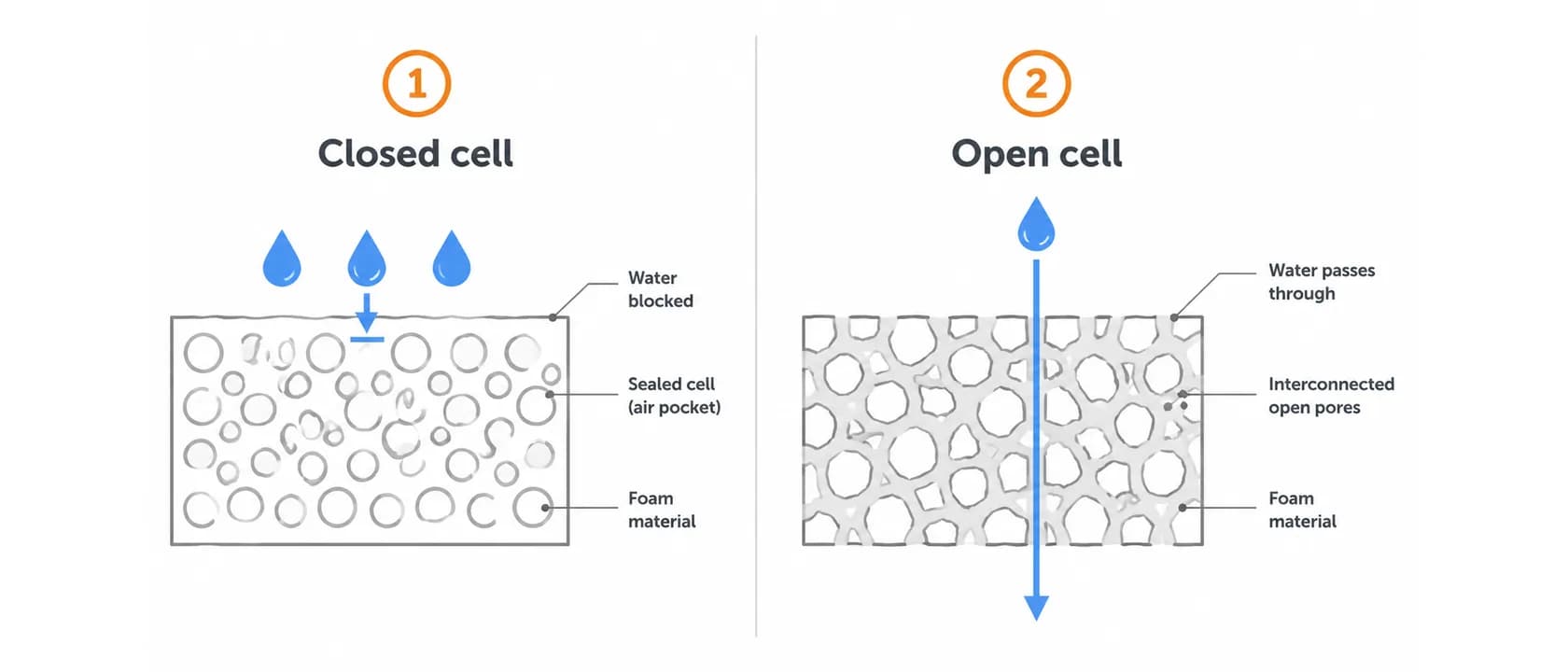
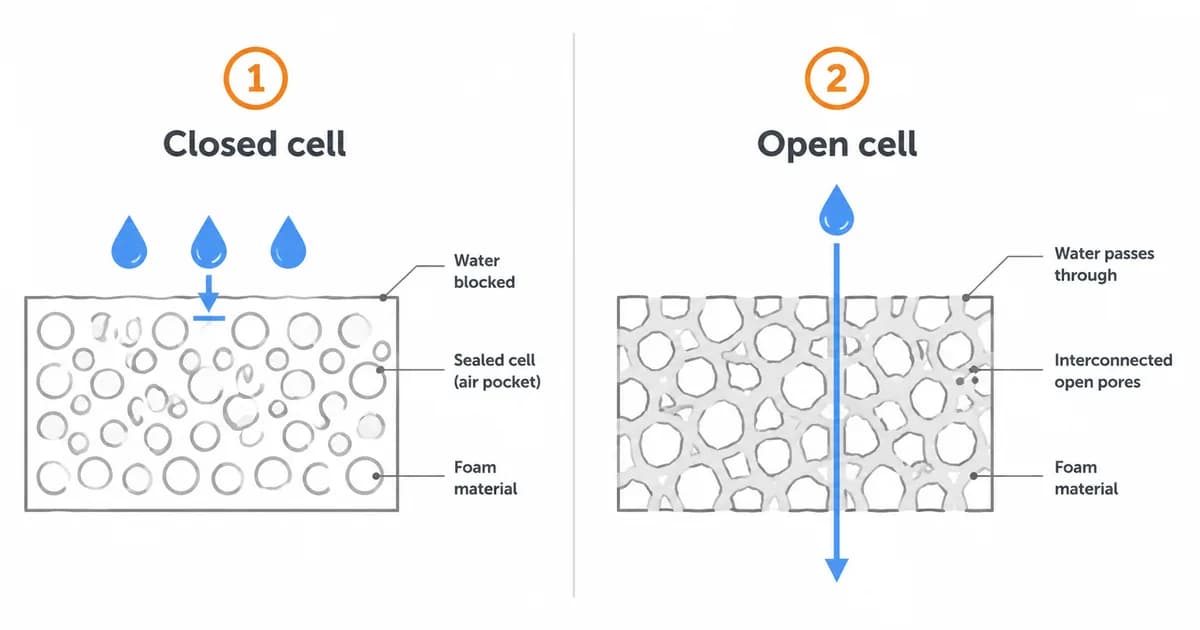
- Closed cell versus open cell: closed-cell materials have sealed voids and block water, dust, and air — they can seal. Open-cell foams pass fluid and air by design and cushion or damp sound, but they do not seal, no matter how well they are cut. Specifying an open-cell foam for an IP-rated joint is one of the most common material errors in this category.
Adhesive-Backed Die Cut Gaskets
A gasket cut from sheet stock can be laminated with pressure-sensitive adhesive before cutting, so the finished part arrives with a peel-off liner on one face. For assembly this changes the job entirely: the operator peels and places the gasket into position and it stays there through the rest of the build, with no fixture, no adhesive dispensing, and no chance of the gasket slipping out of the groove while the lid goes on. Kiss-cutting keeps the parts on a continuous liner in sequence, which is what makes automated or high-rate manual placement practical.
The critical point to keep straight: the adhesive is not the seal. It is a positioning aid. Sealing is still done by compression between the mating surfaces, and a joint that relies on the adhesive bond to hold back water or dust is designed wrong. This distinction matters when specifying, because it means adhesive selection is governed by what the gasket must stick to during assembly, not by the sealing requirement.
Acrylic adhesives suit long-term service, elevated temperature, and most metals and high-surface-energy plastics; rubber-based adhesives grab harder immediately and adhere better to low-surface-energy plastics such as polypropylene and polyethylene, but they soften at temperature. Two practical details are worth designing in early: a PSA layer adds thickness to the stack, typically in the range of 0.05–0.2 mm depending on the system, which must be accounted for in the compression calculation; and on very soft foams the adhesive layer slightly stiffens the bonded face, so the effective CFD is not quite the raw material value. Extended liner tabs can be cut into the part so operators can grip the liner without touching the adhesive face.
What to Specify When Ordering Die Cut Gaskets
The fastest quotes come from requests that describe the joint, not just the part. A converter can select material and construction from a description of the sealing problem, but only if the problem is stated.
Send a dimensioned drawing or DXF with the outline, holes, and any internal cutouts, plus the material thickness. Then add the four things that are usually missing: the gap or compression range the gasket must work across, the service temperature and what the gasket is exposed to, the closure force or fastener pattern available, and whether the part needs adhesive backing and on which face. If a material is already qualified, name it; if not, describe the requirement and let the converter propose one. For anything that must meet an ingress rating, say which rating — a joint targeting IP65 is a different design from one that merely needs to keep dust out.
Frequently Asked Questions
What is a die cut gasket?
A die cut gasket is a gasket produced by cutting sheet or roll material — silicone sponge, PU foam, EPDM, neoprene, PTFE — with a shaped die, rather than molding it in a cavity. The result is a flat part with the outline, bolt holes, and internal cutouts already cut, ready to place into a joint. Because tooling is inexpensive and cutting is fast, die cutting is the most economical method for flat gasket profiles from prototype quantities up through production volumes.
What is the difference between a gasket and a seal?
A gasket seals a static joint — two surfaces bolted or clamped together, such as an enclosure lid or a flange — and works by being compressed between them. A seal generally refers to a dynamic interface where one surface moves relative to the other, such as a rotating shaft or a sliding rod. Die cut parts are almost always static gaskets, which is why material selection focuses on compression behavior: compression set, force-deflection, and recovery over the service life.
Which gasket material is best for outdoor or high-temperature sealing?
For outdoor exposure, EPDM is the standard choice — excellent resistance to weather, ozone, UV, and water at low cost, across roughly −50 °C to +120 °C. For higher temperatures or where both heat and weathering apply, silicone sponge or solid silicone covers roughly −55 °C to +200 °C for common grades and resists UV and ozone indefinitely. Neither is suitable where petroleum oils or fuels are present; nitrile is the material for oil contact, at the cost of poor UV resistance.
Can die cut gaskets be supplied with adhesive backing?
Yes. The gasket material is laminated with a pressure-sensitive adhesive before cutting, so parts arrive on a peel-off liner and can be placed and held in position during assembly. Acrylic adhesives suit long-term and elevated-temperature service and most metals; rubber-based adhesives bond better to low-surface-energy plastics such as polypropylene. The adhesive positions the gasket — it is not the seal, which is still made by compression between the mating surfaces.
What tolerance can be held on die cut gaskets?
Tolerance depends on material and thickness rather than on the shape. PORON microcellular PU foam holds approximately ±0.1 mm on precision flatbed equipment, the best of any foam; silicone and EPDM rubber sheet in the 1–6 mm range typically holds ±0.15–0.25 mm, with die offsets compensating for spring-back; PTFE cuts to about ±0.1 mm with minimal spring-back. Softer and thicker materials sit at the looser end because they compress under the cutting die and relax afterward.
Request Custom Die Cut Gaskets
ALS Tape die-cuts gaskets from silicone sponge, PORON microcellular PU, EPDM, neoprene, and PTFE — with or without adhesive backing, prototype through production. Send a drawing or describe the joint you need to seal, and we respond within one business day.
Contact ALS Tape