Most rubber gasket material guides stop at a chemical compatibility chart. This one goes one step further, into the part of the decision that only shows up once the material reaches a converter: how each elastomer behaves when it is die cut, what tolerance it will actually hold, and whether it can carry adhesive backing. Choose the compound for the fluid and the temperature, then confirm the format — thickness, hardness, solid or sponge — will convert into the part you need.
What Counts as Rubber Gasket Material
Rubber gasket material is elastomer supplied in sheet or roll form, cut into flat gaskets that seal a static joint by compression. It covers the synthetic elastomers — EPDM, neoprene, nitrile, silicone, fluoroelastomer, butyl, SBR — in solid, sponge, or closed-cell form, with or without a pressure-sensitive adhesive laminate on one face.
It is worth drawing the boundary early, because the phrase gets used loosely. Compressed fiber, cork, and paper gasket stock used on engine and machinery flanges are a different family with different selection rules, and they are not what a tape and foam converter cuts. Molded rubber gaskets — formed in a cavity rather than cut from sheet — are also a separate route, chosen when the part needs a three-dimensional profile rather than a flat cross-section. Everything below concerns flat elastomer sheet converted into die cut parts.
The Common Rubber Gasket Materials, Compared
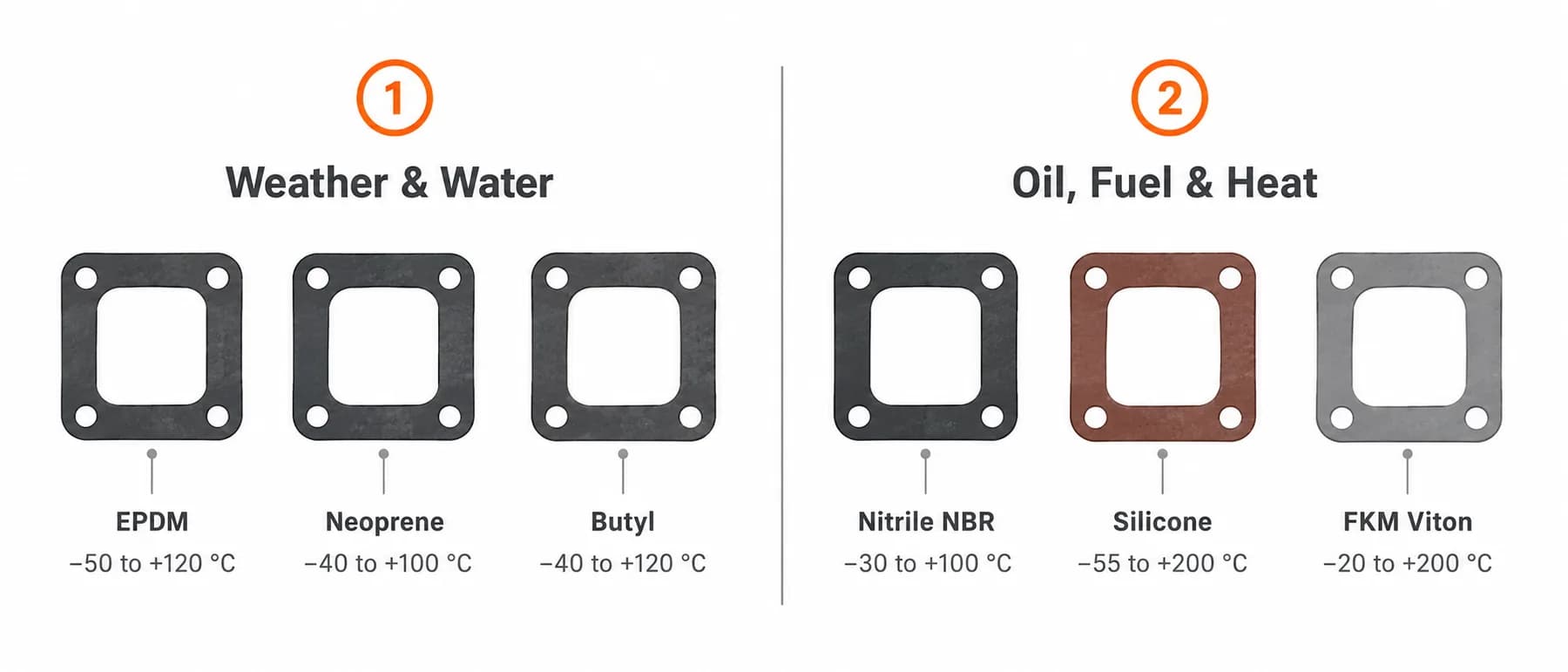
Seven compounds cover the large majority of flat gasket work. They divide cleanly into two groups by what they resist, and picking the wrong group is the most expensive mistake in gasket selection — a weather-grade rubber in an oil line fails in weeks.
Weather, Water, and General-Purpose Group
- EPDM — roughly −50 °C to +120 °C. The default for outdoor and water service: excellent resistance to weather, ozone, UV, steam, and dilute chemicals, at low cost. Swells badly in petroleum oils and fuels, which is its one hard limit.
- Neoprene (CR) — roughly −40 °C to +100 °C. The balanced compound: moderate oil resistance, good weather and ozone resistance, inherently flame-retarding. Chosen when a joint sees some oil mist and some weather and neither is severe.
- SBR — roughly −40 °C to +100 °C. The economy option for dry, indoor, non-critical sealing and cushioning. Poor oil, ozone, and weather resistance; specify it only when the environment is benign and cost dominates.
- Butyl (IIR) — roughly −40 °C to +120 °C. Notable for very low gas permeability, so it is the choice where the joint must hold a gas or vacuum rather than merely block dust and water.
Oil, Fuel, Chemical, and High-Temperature Group
- Nitrile / NBR (Buna-N) — roughly −30 °C to +100 °C. The standard for petroleum oils, fuels, and hydraulic fluids. Poor ozone and UV resistance, so it is a poor choice for anything exposed outdoors.
- Silicone — roughly −55 °C to +200 °C for common grades. The widest temperature range of the group plus excellent ozone, UV, and weather resistance, and it is available in FDA-compliant grades. Weak in tear strength and abrasion, and it is attacked by petroleum oils and fuels.
- Fluoroelastomer / FKM (Viton) — roughly −20 °C to +200 °C. The chemical-resistance answer: fuels, solvents, acids, and high temperature simultaneously. Specified when nothing cheaper survives the exposure, because it is several times the cost of the others.
Two of these ranges deserve a caveat. Published temperature limits are for continuous service in air; intermittent peaks can run higher, while a compound under compression in contact with a fluid usually derates. And within each compound there are dozens of formulations — a specific grade's datasheet, not the family average, is what should be qualified against a demanding joint.
Selecting by What the Gasket Actually Touches
Working backwards from the exposure gets to a shortlist faster than working forwards from a material preference. In practice, most requests resolve along five paths:
- Outdoors, rain, sunlight, ozone — EPDM first; silicone where the temperature also runs high; never nitrile or SBR.
- Petroleum oil, fuel, hydraulic fluid — nitrile first; FKM where temperature or aggressive solvents rule nitrile out; never EPDM.
- Steam, hot water, dilute acids and alkalis — EPDM; check the specific grade against the concentration and temperature.
- Sustained heat above about 120 °C — silicone or FKM; the choice between them is decided by whether oils and fuels are present.
- Food, beverage, or potable water contact — specific grades of silicone or EPDM certified to the relevant standard, such as FDA 21 CFR 177.2600 for rubber articles in repeated use. Compliance is a property of the individual grade and its certification, not of the elastomer family.
Solid, Sponge, or Closed-Cell — the Format Decision
The compound answers what the gasket can survive. The format answers whether it will seal at the force the assembly can actually apply, and this is where a lot of otherwise correct material choices go wrong.
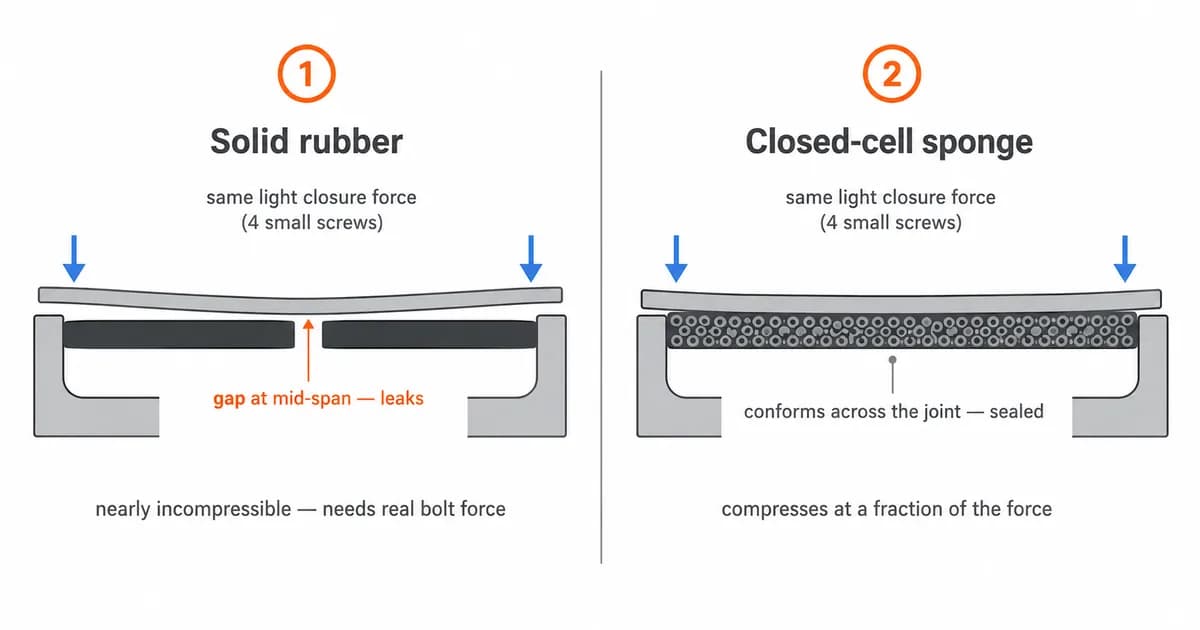
Solid rubber sheet is dense and nearly incompressible. It seals well against flat, rigid, well-clamped surfaces with substantial bolt force, and it is the right format for flange joints. Ask it to seal a thin sheet-metal cover with four small screws and it will not compress enough to conform — the joint leaks despite a perfectly suitable compound.
Sponge and closed-cell rubber contain a cellular structure that collapses at a fraction of the force. Closed-cell grades keep the cells sealed from one another, so the material itself blocks water and dust; open-cell sponge does not and should not be used where ingress matters. For enclosure lids, access panels, and any joint closed by light fasteners or snap fits, a closed-cell sponge grade in the right thickness usually outperforms solid rubber of the same compound.
Microcellular polyurethane such as PORON sits alongside these as a separate option: it is not a rubber, but it competes for the same enclosure gasket applications and generally beats rubber sponge on compression set — meaning it stays sealed over years of service rather than taking a permanent set. Where long-term recovery is the governing requirement, it belongs on the shortlist.
Hardness and Thickness
Hardness for solid rubber is quoted on the Shore A scale. Gasket stock generally falls between 40 and 80 Shore A: 40–50 conforms readily to imperfect surfaces and needs less closure force; 60–70 is the general-purpose middle; 80 and above resists extrusion under high bolt loads but demands real force to seat. Sponge and cellular grades are not meaningfully described by Shore A at all — they are specified by density and by compression force deflection, the pressure needed to compress the material by a stated percentage, which is the number that actually predicts whether the joint will close.
On thickness, the useful rule is that a gasket must be thick enough to absorb the total gap variation it will see — surface flatness, warp, and fastener spacing combined — while still being compressed within its working range. Too thin and the gasket bottoms out at the high spots and leaves gaps elsewhere; too thick and it squeezes out sideways, or the joint never reaches the compression the seal depends on. Where the gap is uncertain, the sound approach is to measure the worst-case variation across the joint and select thickness from that, rather than defaulting to a round number.
How Each Material Behaves Under a Cutting Die
This is the layer that rarely appears in a materials chart, and it is where a specification either converts cleanly or turns into a tooling problem. Elastomers deform before they cut: the die compresses the material, cuts it, and the material relaxes afterwards. How much it relaxes is what sets achievable tolerance.
Rubber gasket materials are almost always cut on flatbed equipment rather than rotary, because the stock is thick, soft, and often supplied in sheets. Practical behavior by material:
- Silicone — springs back noticeably; dies are cut with an offset to compensate. Solid and sponge silicone in the 1–6 mm range typically holds ±0.15–0.25 mm. Low tear strength means narrow webs and small internal features need care in the die design.
- EPDM and neoprene sheet — predictable, forgiving stock in the same ±0.15–0.25 mm band for 1–6 mm thickness. The most straightforward rubber to convert, which is part of why it is so widely specified.
- Nitrile — cuts cleanly and holds tolerance comparable to EPDM; the constraint is service environment, not converting.
- FKM — cuts well but is expensive per sheet, so nesting efficiency and scrap rate matter more than usual to the quoted price of the part.
- Closed-cell sponge and foam — compresses substantially under the die, so it sits at the looser end of the tolerance range; thicker and softer stock loosens further. PORON microcellular PU is the exception, holding approximately ±0.1 mm on precision flatbed equipment — the best of any cellular material.
- Adhesive-laminated stock of any of the above — cuts to the same tolerance as the base material, but the PSA layer adds thickness to the stack, typically 0.05–0.2 mm depending on the adhesive system, which must be included in the compression calculation rather than treated as free.
Two design details are worth settling before tooling is cut, because both are cheap to include up front and expensive to retrofit: whether parts should be kiss-cut on a continuous liner for peel-and-place assembly, and whether an extended liner tab is needed so operators can grip the part without touching the adhesive face.
Specifying Rubber Gasket Material for a Quote
A converter can select the compound if the requirement is described, but the requirement has to be there. The fastest quotes name the exposure, not just the material.
Include the fluid or environment the gasket contacts and the service temperature range; the gap or compression range the part must work across; the closure force or fastener pattern available; the thickness and, if already qualified, the compound and hardness; and whether adhesive backing is needed and on which face. Send a dimensioned drawing or DXF with the outline, bolt holes, and internal cutouts. If the material is not yet chosen, describing the joint is enough to start — the compound and format can be proposed from that, and confirmed against a sample before tooling is cut.
Frequently Asked Questions
Which rubber gasket material resists oil and fuel?
Nitrile (NBR, Buna-N) is the standard choice for petroleum oils, fuels, and hydraulic fluids, at roughly −30 °C to +100 °C. Where the same joint also runs hot or sees solvents and acids, fluoroelastomer (FKM, Viton) covers both at roughly −20 °C to +200 °C, at several times the cost. EPDM and silicone should not be used in petroleum service — both swell and soften in contact with oils and fuels regardless of how well they perform on temperature or weather.
What is the difference between EPDM and neoprene gasket material?
EPDM is the better weather material: superior resistance to ozone, UV, water, and steam, and it costs less. Neoprene trades some of that weather performance for moderate oil resistance and inherent flame-retarding behavior. The practical rule is that a joint exposed to weather and water takes EPDM, a joint that sees occasional oil or grease alongside moderate weather takes neoprene, and a joint in continuous oil contact takes neither — it takes nitrile.
Is solid rubber or sponge rubber better for a gasket?
It depends on the closure force available rather than on which material is better. Solid rubber is nearly incompressible and seals well on rigid, heavily clamped flange joints. Sponge and closed-cell grades compress at a fraction of that force, which is what makes them right for enclosure lids, access panels, and any joint closed by light fasteners or snap fits. Use closed-cell rather than open-cell wherever water or dust ingress matters, since open-cell structure lets both pass through the material itself.
Does adhesive backing change which rubber gasket material I should choose?
It does not change the compound decision, which is still governed by fluid and temperature exposure, but it adds two constraints. The adhesive has to bond to the surface the gasket mounts on — acrylic systems suit metals and high-surface-energy plastics and hold up at temperature, while rubber-based systems bond better to low-surface-energy plastics such as polypropylene. And the adhesive must survive the same service temperature as the gasket, which occasionally rules out a PSA on a high-temperature silicone part and makes a mechanically retained gasket the better answer.
What thickness of rubber gasket material should I specify?
Select thickness from the total gap variation the joint will see — surface flatness, warp, and fastener spacing combined — so the gasket can absorb the worst case while still being compressed within its working range. A gasket that is too thin bottoms out at the high spots and leaves gaps elsewhere; one that is too thick extrudes sideways or never reaches the compression the seal depends on. If the gap variation has not been measured, measuring it is the step that makes the thickness decision straightforward.
Which rubber gasket materials are suitable for food contact?
Specific grades of silicone and EPDM are produced to food-contact standards such as FDA 21 CFR 177.2600, which covers rubber articles intended for repeated use. Compliance is a property of the individual grade and its certification, not of the elastomer family — an EPDM sheet is not food-safe simply because it is EPDM. When a part has a food, beverage, or potable water requirement, state it in the request so a certified grade is quoted and the documentation is supplied with the parts.
Get a Rubber Gasket Material Recommendation
ALS Tape converts silicone, EPDM, neoprene, nitrile, PTFE, and PORON into die cut gaskets — solid, sponge, or adhesive-backed, prototype through production. Send a drawing or describe the joint and the fluid it sees, and we will confirm compound, format, and tolerance before tooling is cut.
Contact ALS Tape